Barbara La Marr: Did The Girl Who Was Too Beautiful Digest a Tapeworm to Lose Weight?
She was heralded for her legendary beauty. A mythic crash diet became her legacy.
CONTENT WARNING: This piece discusses diet culture, disordered eating, and tapeworms.
As I mentioned in my piece on Nita Naldi's pork chop and pineapple diet, Hollywood's penchant for extreme weight loss is almost as old as the film industry itself. From the earliest days of the fan magazines and creation of the movie stars they obsessed over, women's bodies were derided as unbecoming for their die-hard fans. It is the easiest method our society has for “putting women in their place.” You could literally be too pretty, according to your own industry, and that wouldn’t stop the noise. For Barbara La Marr, her reputation as “the girl who is too beautiful” was mired by a life of crash dieting, hard partying, and a long-standing rumour about a tapeworm that became Hollywood lore.
Reatha Dale Watson arrived in Hollywood as a two-time divorced adolescent with her third husband on her arm. She'd had a wild few years as a teen that involved making the headlines thanks to some drama involving an accidental kidnapping, which led to some dramatic newspaper headlines. Now, she was going by the name Barbara La Marr and earning a decent living as a screenwriter for Fox. To earn some extra money, she danced at events across the country, where she ended up sharing the floor with the likes of Rudolph Valentino.
The legend goes that, while doing some writing work at United Artists, Barbara was approached by Mary Pickford, the queen of Hollywood, and told, "My dear, you are too beautiful to be behind a camera. Your vibrant magnetism should be shared by film audiences." So, by 1920, she was also working as an actress. She landed her first big role in 1921 when she played Milady de Winter in the Douglas Fairbanks-starring adaptation of The Three Musketeers.
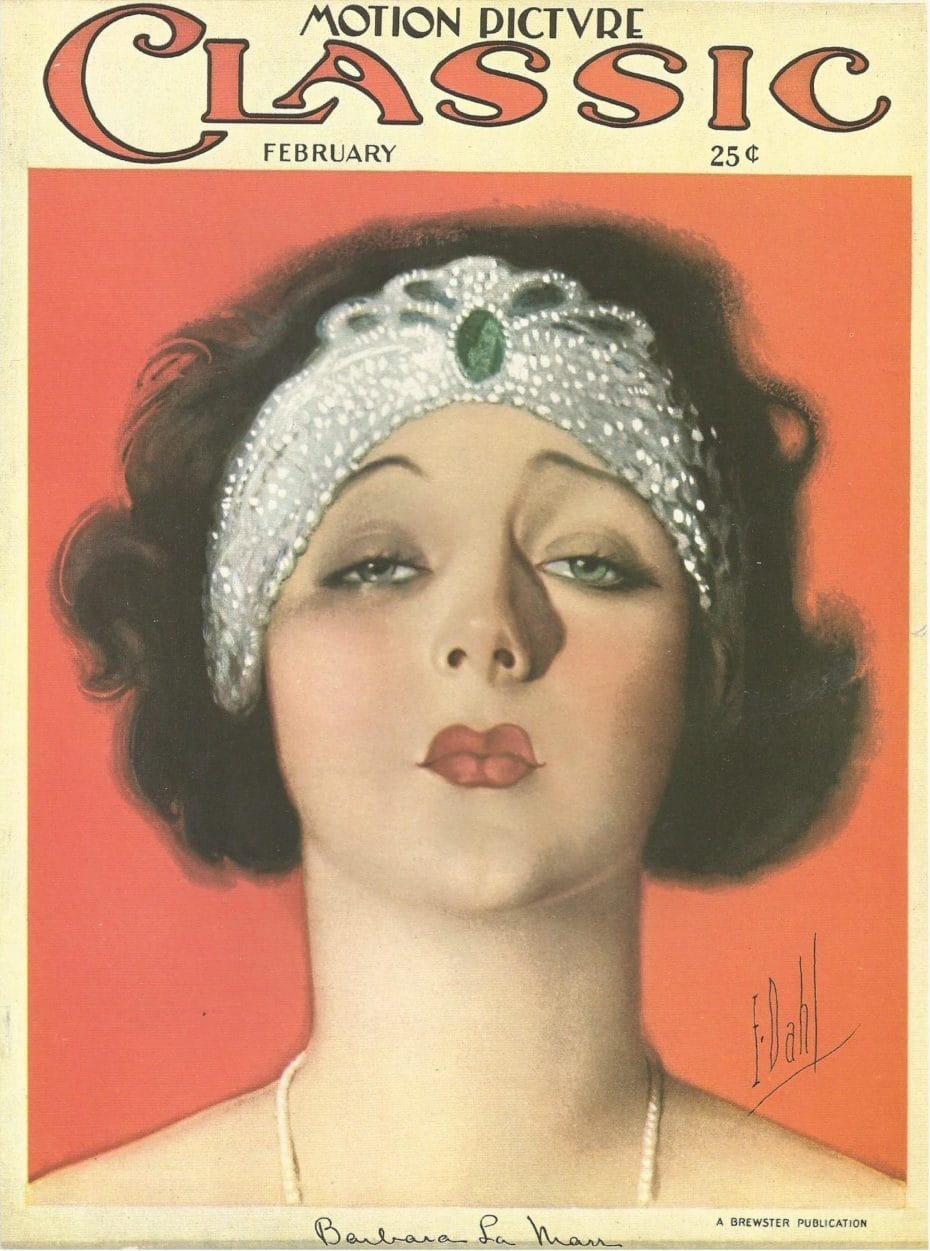
In the June 1922 issue of Photoplay, Adela Rogers St. Johns wrote a profile of La Marr that crowned her “The Girl Who Is Too Beautiful.” She recounted an alleged incident wherein a "kindly old judge" had seen the then-teenage Barbara in the street and told her, "Go back to the country, back to your folks. You're too beautiful. You don't understand where it might lead you." Said St. Johns, "I have seen a good many beautiful women in my time. Of them all, Barbara La Marr was the most exquisite girl I have ever seen." But as glowing as the piece is, it's also a cautionary tale that treats her as though she will inevitably be ruined by the business. St. Johns wrote a lot of pieces like this, ones that were both adverts for Tinseltown and giant warning signs of its corruptive power. In that same issue, she wrote a piece on the "New American beauty" that prized "the fragile, girlish type" of Lillian Gish and Mary Pickford, who were both frequently cast as young girls. Barbara, by contrast, is dangerous in her beauty. How could anyone resist?
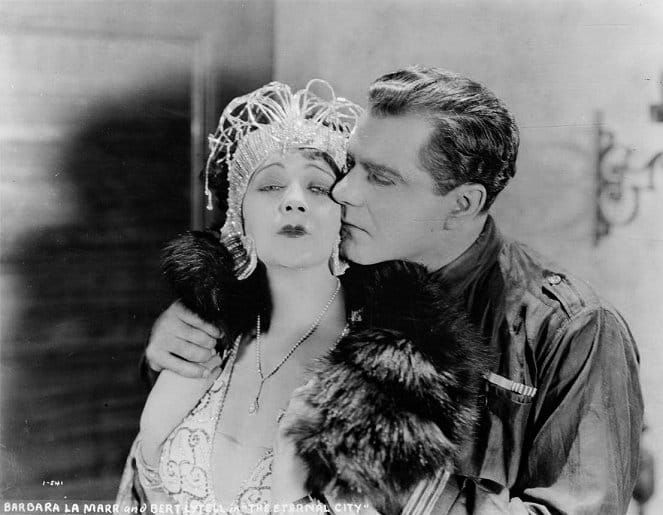
That story with the judge was most likely made up by La Marr's studio to bolster her image as a rising star and a vamp, and it certainly worked. She appeared in well over 20 movies after that, and acted alongside stars like Ramon Novarro, Lon Chaney, and Lionel Barrymore. In one film, 1923’s The Eternal City, she convinced both the King of Italy and Benito Mussolini to star. That is a thing you could do in the ‘20s.
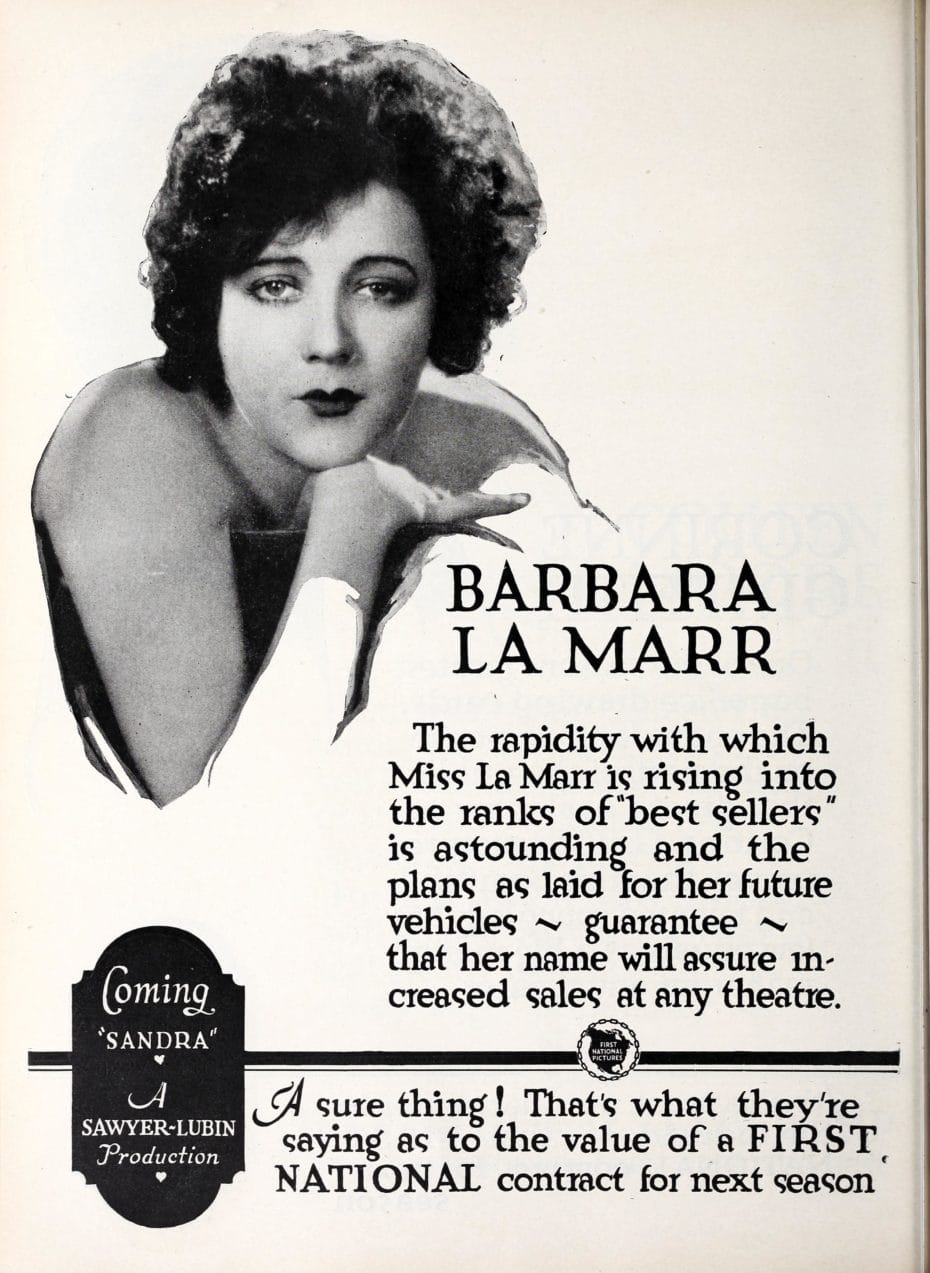
Befitting her vamp image, Barbara loved two things: men and partying. She would divorce husband number three and marry again, to the actor Jack Dougherty, who also didn't last long. She claimed to only need two hours of sleep a night, which allowed her to go out on the town as often as she desired. But soon, the drinking became a problem. While working on a drama called Thy Name is Woman, producer Irving Thalberg made regular set visits to check that Barbara's drinking wasn't causing any trouble for the director. The booze left her in poor health. But so did her dieting.
According to one "authority" on La Marr, Jimmy Bangley, by 1924, "over-indulgence in food, alcohol, and drugs had begun to show their ill effects. Barbara reacted by going on a starvation diet of cocaine and liquids (including those potent Barbara La Marr highballs). She quickly lost the weight but ruined her health, and she never fully recovered. It was ever rumored that she digested sugar-coated tape worms because she was so desperate to lose weight."
My apologies for how gross the rest of this piece is going to get.

Did anyone else hear rumours of tapeworm diets among the rich and famous when they were younger? I swear I heard that urban legend almost as frequently as I did the one about Marilyn Manson having some ribs removed so he could self-fellate. Or the whole Richard Gere and the gerbil nonsense (which I wrote about here!) But tapeworm diet rumours are actually pretty damn old. Maria Callas was the subject of such a rumour after she dropped a ton of weight. She actually did contract a tapeworm at one point thanks to her love of raw beef, but her drastic body transformation was the result of a brutal diet that involved swallowing iodine.
Dr. Louise Foxcroft, a historian and author of Calories and Corsets: A History of Dieting Over 2,000 Years, told the BBC that the tapeworm diet started being advertised during Victorian times. Patients would be given the worm in pill form, and the theory was that the horrible sickness it induced, which usually included symptoms of weight loss and vomiting, would help the pounds fly off. Once you'd reached your target weight, you'd kill off the tapeworm with an anti-parasitic pill and then, uh, it would exit your system. This is not scientifically sound, you'll be shocked to discover. Getting rid of a tapeworm isn't something you can time to a diet regimen. They can get stuck in there and cause a lot of damage to your intestines. Did you know that those things can grow up to nine metres in length?
I’ve struggled to find proof that Barbara La Marr actually did this diet. In fairness, even the most fawning profile or fan magazine would have trouble spinning this as a good thing (it was also not exactly legal so that couldn’t have helped.) A couple of biographies mention it but never go into detail, but they also don’t talk much about what these oft-discussed crash diets entailed. Given how extensively documented many of the stars of this era’s diets were, I did find this intriguing.
It did give me the sense that her studio may have wanted to keep her issues out of the press. By 1925, La Marr was in a terrible state. A case of pulmonary tuberculosis had left her weakened and led to a collapse on the set of her final film, The Girl from Montmartre. She was then diagnosed with an inflammation of the kidneys, which kept her bedridden over Christmas. A month later, on January 20, 1926, Barbara La Marr died. She was 29. She left behind her son, Marvin, who would be raised by her good friend, the actress and comedienne ZaSu Pitts.
A 1926 Photoplay piece titled “The Price They Paid for Stardom” wondered, in a rather victim-blamey way, if those who had struggled in the public eye "profit by their popularity" or were "victims of fate." La Marr is included alongside Wallace Reid, a dashing leading man who "worked himself to death" (but was also a drug addict), Harold Lockwood, who died of the Spanish flu in 1918, and Belle Bennett, whose son had died while she was making the film Stella Dallas.
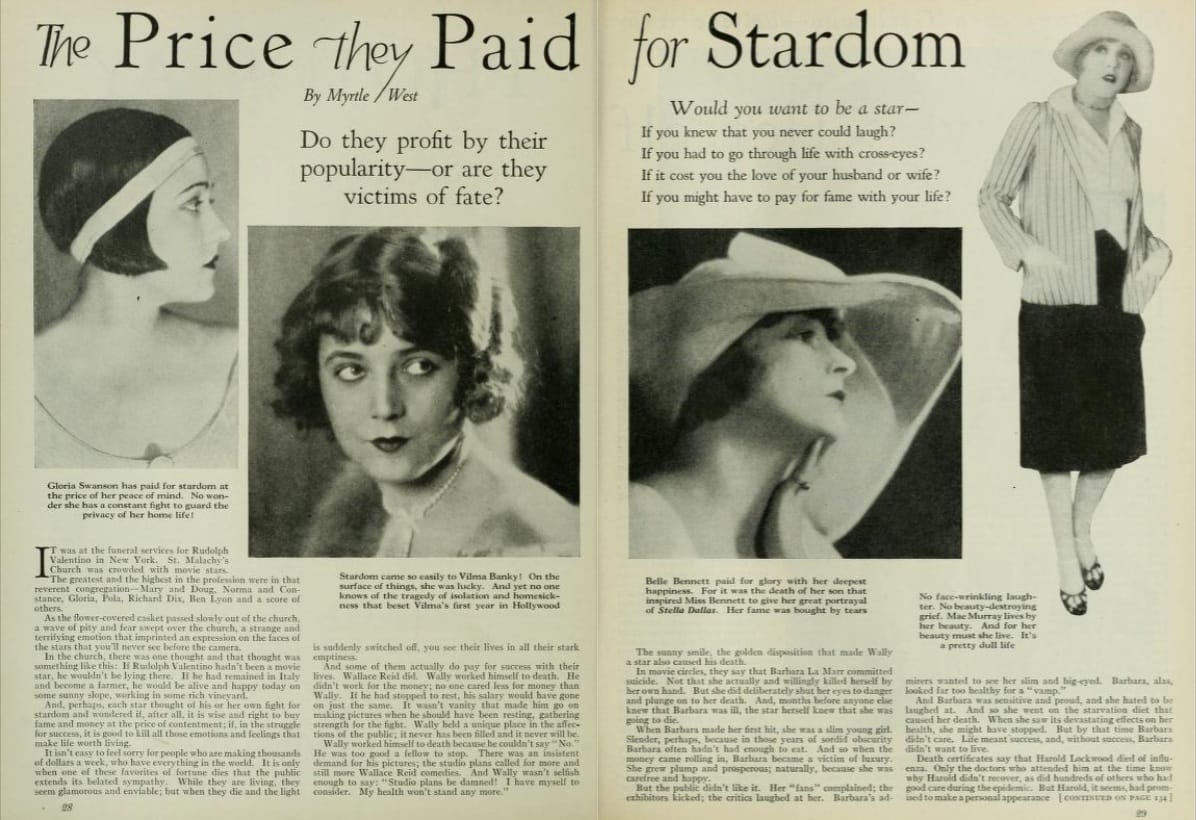
Photoplay wrote that La Marr "committed suicide. Not that she actually and willingly killed herself by her own hand. But she did deliberately shut her eyes to danger and plunge on to her death." The piece scolds her for gaining weight, claiming she "was a slim young girl" in her first film, but "when the money came rolling in, Barbara became a victim of luxury. She grew plump and prosperous [...] But the public didn't like it." So, she "went on the starvation diet that caused her death." They also claimed that she "had, at a period preceding her collapse, taken a thyroid treatment to lose weight." I couldn’t find hard proof of that, but I did find a lot of sources that claimed she was on much harder drugs.
One biography of Jean Harlow claims that La Marr's death had been drug-related but that "a concocted studio release" covered it up. A similar claim comes in a biography of ZaSu Pitts. But the legend certainly stuck that it was "reducing" that killed Barbara La Marr. It’s one of those claims I see a lot of in more contemporary coverage, more like an assumption than something with hard evidence. Sherri Snyder's 2017 biography of La Marr claims the drug use rumours were untrue. She quotes Ben Finney, a close friend of La Marr, as noting, rather grimly, "She did well enough with booze" without needing morphine.
Certainly, La Marr’s poor health and tuberculosis struggles were not helped by her alcoholism or history of crash diets. If she did have a tapeworm, that would have only made things more painful. And history has cemented her image not as The Girl Who Is Too Beautiful but as a victim of Hollywood’s body fascism. But she wasn’t alone. There are so many women from the 1910s onward who were adored as silver screen idols, then became these sacrificial lambs on the altar of skinniness. Just make sure to blame the victims themselves for their deaths. It’s easier than the alternative.