Review: Digger is Deeply Irritating and a Bad Satire
Alejandro G. Iñárritu and Tom Cruise team up for a satire about satire that's less than meets the eye.

WARNING: This review contains major spoilers for Digger.
Digger Rockwell (Tom Cruise) is a vulgarian of obscene wealth and power. An oil baron who inherited his family fortune, he cares for nothing and nobody except his half-dead cat and his own ego. When his top scientists inform him that decades of uninterrupted drilling have left the planet on the verge of climate catastrophe, it’s up to him to save the world, or something. But not really.
Look, cards on the table here: I do not like Alejandro G. Iñárritu’s films. I have never gelled with this filmmaker. Every time I give him a shot, I’m left with the same response: great actors, an excellent array of technical prowess, and it was all in service of vapid nonsense. Birdman was smarmy as hell, Babel feels like an undergraduate lecture, The Revenant confuses suffering for pathos, and Bardo thought that pointing out its self-satisfaction was the same thing as puncturing it. So I knew the chances were high I would not like Digger, especially once the reviews came out and even Iñárritu fans seemed exhausted by its cavalcade of sound and fury. And yes, I did not like it, but the ways I did not like it were a surprise, so that’s an improvement for this director!
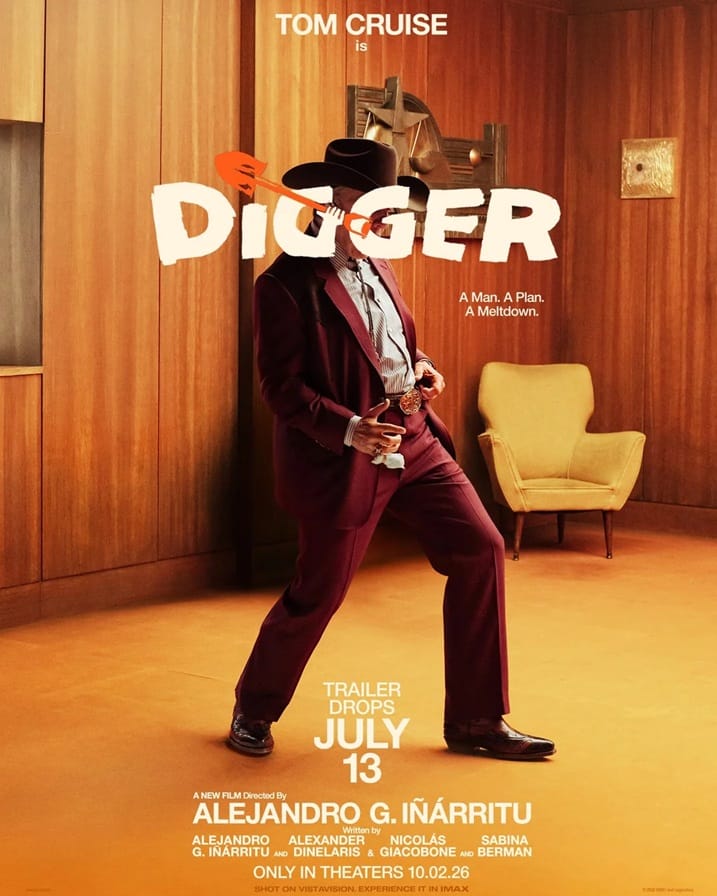
Tom Cruise, slathered under heavy make-up and prosthetics, is a suitably intense buffoon as Digger, a man with no volume control and a disdain for subtlety. But it’s not just him. Everyone is turned up to 11, whether it’s John Goodman ranting as the U.S. President or Sandra Hüller as Digger’s shrill half-sister. Everyone says how they’re feeling at any given moment, and their contempt for the planet is equally direct. The only one who seems to have a soul is Dr. Ganesh, played by Riz Ahmed, and everyone makes a point of either ignoring his evidence or mocking his pleas. Typical for Iñárritu, it’s big and deafening and impeccably decorated, but stunning set design can only cover for so much. It takes no time at all for things to become tedious. And then…
It’s impossible to talk about why Digger is a failure without “spoiling” the big reveal that has been kept out of all the trailers. I guess it’s a first-act twist. Certainly, the marketing thinks it’s worth hiding the real purpose of the film. About 20 minutes in, a tree falls in the background, and a seemingly giant man picks it up. The sets move to reveal that this is all fake. These people are actors, rehearsing for a play called Fossil Fools, a satirical biography about the real Digger Rockwell and the politicians who doomed the planet to an ecological hellscape. “Digger” is Curtis Markson, a dissatisfied actor who is worried about his daughter’s missing flight home and is dissatisfied with the script. He wants the play to be more like reality, less goofy and caricature-driven than the pantomime of yelling and rectum jokes he’s currently spewing. But the show must go on, because it’s a ludicrously over-the-top theatrical production that might be literally impossible, and the people must laugh.
This break from the story audiences were expecting means we must watch the story of Digger Rockwell as a play, albeit one presented to us via Iñárritu and cinematographer Emmanuel Lubezki’s camera as an impressive array of cinematic tricks. So now, the endless yelling and lack of nuance “makes sense”? It’s for the cheap seats of an in-house audience while us, the paying customers, must tolerate the shake-up in theme. For you see, this isn’t just a satire about the billionaires and politicians who have doomed our planet: it’s a satire about satire itself. How terribly clever, yes? Ugh.
Satire can be brash and unsubtle. The Substance has the depth of a puddle, but that works in its favour as a scathing takedown of self-hatred and impossible beauty standards in a patriarchal hellscape. Robocop is as on-the-nose as it gets, and therein lies its genius. And crucially, those films are also fun. Digger is a “satire” about how satire is pointless and self-important, and to illustrate that, you have to sit through over two hours of bellowing. Iñárritu and his writers seem to believe that the only way to illustrate the notion that modern political humour doesn’t trust the audience is to talk down to them on both the literal and meta level. The jokes are bad because the thesis doesn’t work without them, so you just have to sit through the lecture for some reason. All these amazing actors are wasted in nothing parts because that’s the point. Just yell at people, and they’ll gobble it up because they need to laugh at the inflated ridiculousness of these ogres. We’re not sophisticated enough to confront reality.

I get the feeling that Digger is Iñárritu’s response to far-huffing pompous “we need to save the world” movies like Don’t Look Up, or the entire genre of the Aaron Sorkin monologue, where a great speech by a great man can fix everything. And it’s not a terrible target to put one’s sights upon. I certainly thought Don’t Look Up was terrible, even if I agreed with its politics. A lot of Trump-era satire failed because it thought pointing out the obvious and adding nothing to it was the solution to all of our problems. Remember those Sarah Cooper lip-syncs or the awful Randy Rainbow song parodies? Or SNL’s entire… everything? There is a great film to be made on how the arrogance of rich artistes cloistered from the real world pretend to be truth-tellers while appeasing the mad king or overlooking the big problems. But there is no filmmaker less equipped to pull that off than Iñárritu, who is the kind of artist he claims to mock.
The annoying thing is that I could see how Digger would work, but not with this team. This needed a Yorgos Lanthimos or peak-era Mike Nichols or, hell, Steve Coogan and Michael Winterbottom. None of this worked for me because, as always, Iñárritu is too eager to show off even if it undermines the point he claims to be making. He wants you to be dazzled by long, uninterrupted takes and admittedly incredible production design at the expense of the themes. Why is this play staged like a film and shot as such for us viewers? How does it play to the audience in the theatre given that most of the “jokes” here rely on a close-up or moment of camera framing? How do you even get this many people on stage? I shouldn’t have to think about this stuff. If the point is that misguided satire is a detriment to our societal health, then why are you so eager to win us over with the presentation? Do you want us to feel like idiots for enjoying all your hard work or to give you a pat on the back?
And what of Tom Cruise in all of this? We’ve spent years, ever since Digger was announced, wondering if this would be the film he’d finally win a competitive Oscar for. See, it’s The Last Movie Star going back to Serious Acting. The Academy loves that kind of stuff! All of the above makes judging Cruise’s performance (and everyone else’s, for that matter) difficult. We get glimpses of the real actor playing Digger, an intense and committed worker who feels not unlike Cruise himself, but not enough to make an impact. And we’re supposed to watch the Digger stuff and think it’s too over the top to work. It’s meant to be a poorly directed caricature, and I suppose it is. We’re told the real Digger Rockwell was quiet and unnerving, not a Texan stereotype in a Stetson. Wouldn’t it have been good to see that? I can’t fault Cruise for doing what he was told to. It is often fun to watch, but it’s one note. Yes, that’s the point, but it’s a crap point.

Riz Ahmed is excellent, though, and John Goodman gets in some fine yelling that only he could make work, but hoo boy, you wish the Coen brothers were here to fix a few things. At least those actors got stuff to do. Poor Michael Stuhlbarg is wasted. I don’t think Burn Gorman even got a line to say.
I thought a lot about Megalopolis while watching Digger. I know people who loved that film, but I thought it was a dull mess that did none of the people involved justice. With Megalopolis, people kept telling me that, even if I didn’t like the film, surely I had to admire the ambition. But the film wasn’t ambitious. Yes, the way it was made, with Francis Ford Coppola putting his own money into his decades-old passion project to avoid the studio system, was ambitious. The work itself was actually rather incurious, with such puny scope for both its grand ideas and stylistic execution. Digger felt like that to me: some big ideas but hindered by a smarmily narrow perspective and audience expectations. If I’m going to be lectured at, then you should at least give me the decency of a few good jokes.
Digger is in cinemas now.