Do You Remember: When Martha Stewart Went to Jail
Can you make doilies out of prison bedsheets? Asking for a friend.

Celebrities don’t go to prison. It’s almost a joke at this point how easily the rich and famous can avoid legal accountability. Regardless of the seriousness of the crime, if you’ve got the name, cash, and lawyers in your corner, the worst thing you’ll face is an easily payable fine. When a familiar face has to put on the orange jump-suit and do yard duty, it's a very big deal. When Martha Stewart went to the slammer, the world was stunned.
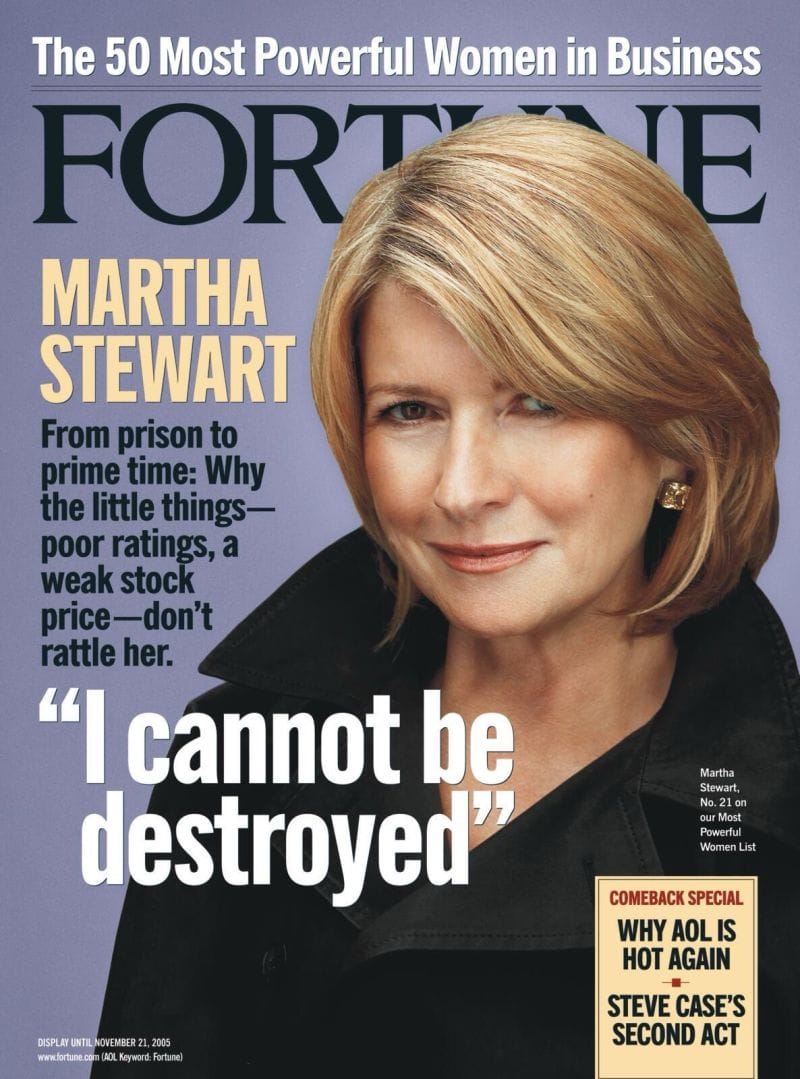
What is there to say about Martha Stewart that hasn't already been said? She is the queen of good living, the perfect host who turned table setting and floral arrangements into a multi-pronged business empire. Everything about her seemed impeccable, from the Nancy Meyers-esque kitchens to the ways she decorated a cake. In the ‘80s and ‘90s, her image was one of scary perfection, as though she could will messiness into neatness with a steely glance.
In her famous New Yorker piece on Stewart, Joan Didion quoted a leaked memo from a Time Inc. executive on the vision of Martha: "She is not, and won’t allow herself to be, an institutional image and fiction like Betty Crocker. . . . She is the creative and driving center. . . . By listening to Martha and following her lead, we can achieve real results in our homes too—ourselves—just like she has. . . . It is easy to do. Martha has already “figured it out.”" Such was the force of her image, one that was both relatable and aspirational. Before influencers, Martha was who the masses wanted to emulate.
It was, of course, the result of decades of ruthless ambition and excellent training. Stewart was born one of six kids and spent her youth babysitting for the children of various New York Yankees players. In college, she did modelling gigs for Chanel to help pay for tuition. In the '60s, she worked as a stockbroker while her then-husband Andrew founded a publishing house. By the '70s, she was running her own catering company and making a big impression among New York City's elite. One happy customer was Alan Mirken, the head of Crown Publishing. He encouraged her to develop a cookbook based around her catering and party-planning skills. 1982's Entertaining was an instant hit. She released, on average, a book a year throughout the '80s, and became a regular in newspaper and magazine columns as well as on TV shows alongside Oprah and David Letterman. Even when she and Andrew divorced, she grew from strength to strength as "the perfect homemaker."
That empire of domesticity expanded in 1990 when Martha signed a massive deal with Time Publishing to develop a magazine. Then came her own TV show. In 1997, she took it to the next level with Martha Stewart Living Omnimedia. It's a rather dystopian-sounding name, right? MSLO was her way of expanding Brand Martha at a record pace, and of keeping all of her assets under one roof. Her company soon included merch, a mail-order catalogue business, floral deliveries, a radio show, and much more. It was never easier or more enticing to fully embody Martha Stewart’s brand of good living. And it made her very, very rich. On October 19, 1999, Martha Stewart Living Omnimedia went public on the New York Stock Exchange. By the end of trading, Stewart was a billionaire, at least on paper. But the uber-rich can always be richer, right?
At the end of 2001, ImClone, a pharmaceutical company, saw its stock price drop drastically when its drug Erbitux, which would be used to treat various kinds of cancer, was denied FDA approval. An investigation by the U.S. Securities and Exchange Commission later found that many executives at ImClone had sold their stocks in the company before the FDA call was made public. That's insider trading, kids. Soon, the arrests started, and guess who was part of the crowd? Martha!