Review: Yorgos Lanthimos Gets Conspiratorial With Bugonia
Emma Stone and Jesse Plemons take on aliens, corporate evil, and bees.
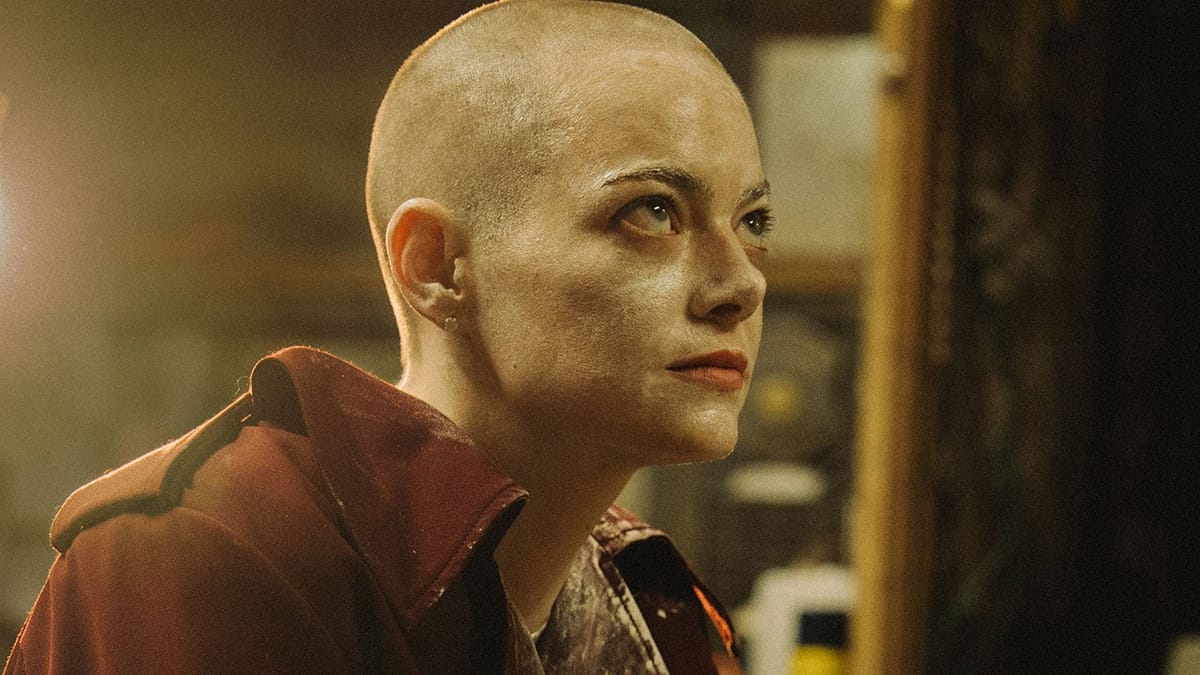
Michelle Fuller (Emma Stone) has it all. As the CEO of her own pharmaceutical company, she’s got money, resources, respect, and the power to do whatever the hell she wants. Teddy Gatz (Jesse Plemons), a low-level employee at Michelle’s company, views her differently. To him, Michelle is an alien, an Andromedan who has infiltrated the human race as part of an intergalactic plan to destroy Earth. Only he is aware of this scheme, and to stop it, he and his cousin Don kidnap Michelle. Now, chained up in Don’s basement, Michelle must navigate an impossible conundrum.

(Image via Focus Features.)
It’s not hard to see what drew Yorgos Lanthimos to a remake of the Korean film Save the Green Planet! The Greek director has long been drawn to bone-dry absurdism with a hefty side-order of nihilism, and this faithful translation of Jang Joon-hwan’s film gives him plenty of material. It’s also undoubtedly fitting for 2025, a year that gave us another Emma Stone film about the brainrot power of conspiracy theories, Eddington. We’ve long moved past the time when tinhatter oddballs in their basements babbling about alien empires, in pop culture and real life, were harmless spectacles.
This is something Lanthimos and screenwriter Will Tracy are aware of. Their protagonist Teddy is a twitchy loser who smarmily insists to his sole ally, his neurodivergent and lonely cousin, that he’s “done his research” and is the sole authority on this matter. He bullies Don into getting chemically castrated to “save” him from the alien wiles, and loses his temper at the drop of a hat. Jesse Plemons is the king of the sinister sad-sack, and he gives a brilliant performance as a tightly-wound man whose justified anger has taken a rotten form. He talks to Michelle about having run the whole gamut of fringe believes, from alt-right to neo-Marxist, in search of the “truth” before falling on his current ethos. So, it’s not all that surprising when he gets violent with the only woman in the room.
In the Korean original, the kidnapped CEO is a man, and while his torturous experience is not downplayed, the dynamic is undeniably changed by this gender flip. Emma Stone, who has found her niche with Lanthimos’s strain of pitch-black oddness, retains her iron spine in the face of near-murderous opposition. She speaks almost entirely in corporate buzz phrases, the perfect 21st-century girlboss, as a defence against Teddy’s lunacy. It makes her a flinty protagonist but Bugonia is too bleak to let either Michelle or Teddy be too sympathetic. Still, that gender flip, which is the most intriguing change from the source material, cannot help but make you more inclined towards Michelle. Seeing Teddy choke her evokes headlines of domestic violence statistics, and often strangulation is the first step towards murdering your spouse. So does hearing him endlessly describe her as not human, rendering her pain moot in his eyes.
It’s interesting to see reviews call Bugonia a comedy, even a dark one. There are some bleak chuckles here and there, which is a Lanthimos staple. But there’s nowhere near as many “laughing in the face of hell” moments as his other films, like Dogtooth or Kinds of Kindness. This is a film about annihilation and every sparse joke feels like that. It’s not even about laughing while the world burns: it’s laughing because staring into the abyss hurts too much. I was again reminded of Eddington, Ari Aster’s “COVID Western” wherein a political squabble breaks out in a small town exacerbated by lockdown tensions. I think that film actually works better than Bugonia on these ideas, largely because the sheer ambition of Aster’s scope more acutely renders the ways that modern American society has become besieged by conspiracy. It bombards you with memes, speculation, rage, bigotry, “just asking questions”, and performativity, encapsulating the ways that our splintered attention spans have gotten to this state.
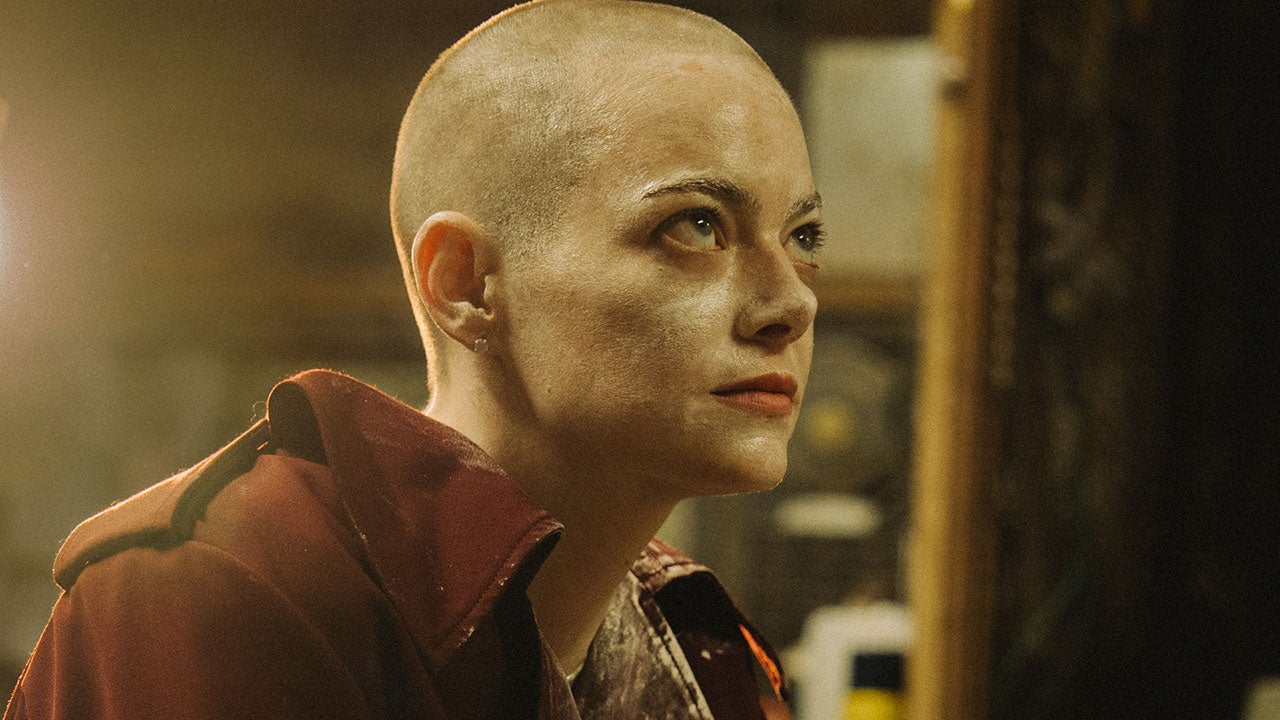
(Image via Focus Features.)
Granted, Bugonia is a more contained tale. Most of the time, it’s a three-hander in a couple of locations, and we have little idea of what’s going on outside of that. We know that Michelle’s company is responsible for a devastation within Teddy’s family, and that the threat of economic devastation is forever looming overhead. This does weaken the overall experience. Turning the story into a micro-battle between man and woman, one mostly dominated by gendered violence, is certainly very Lanthimos-esque in its misanthropy, but many of the wider ideas are either reduced to didactic explanations or left unexplored. The existential crisis that is meant to define the story feels tertiary compared to watching Teddy choke a woman.
The sadness of the film may put off many. Make no mistake: this is a film that really thinks the worst of humanity. There’s a CEO who’s profiting from human and environmental misery, and a radicalised sexist who has no qualms about committing serial violence. The movie practically dares you to care about either of them, and the only one who we are allowed to warm to is Don, played by first-timer Aidan Delbis (shout out to Lanthimos for casting an actor on the autism spectrum for this role.) Poor Don is driven by love for his only family member and watching him be manipulated is heart-wrenching. You know from the moment he is introduced that things won’t end well for him. Or anyone, really.
Bugonia is nowhere near Lanthimos’s best, or even his weirdest (this dude made Dogtooth.) The richness of the lead performances buoys a lot of its flimsier ideas, and the gender swap does allow for a more tangled personal dynamic where the thematic one is left lacking. But I couldn’t help but feel like something was missing, that there was much territory left unexplored amid these lofty ideas and a commitment to emotional hopelessness. Frankly, it’s too easy to get the audience to root for the destruction of the planet. The real work is in making us feel the stakes, and Bugonia stumbles.