Review: Martin McDonagh’s Wild Horse Nine Takes on American Imperialism With a Very Dark Sense of Humour
Hitmen, imperialism, and pitch-black banter: it's all very Martin McDonagh.
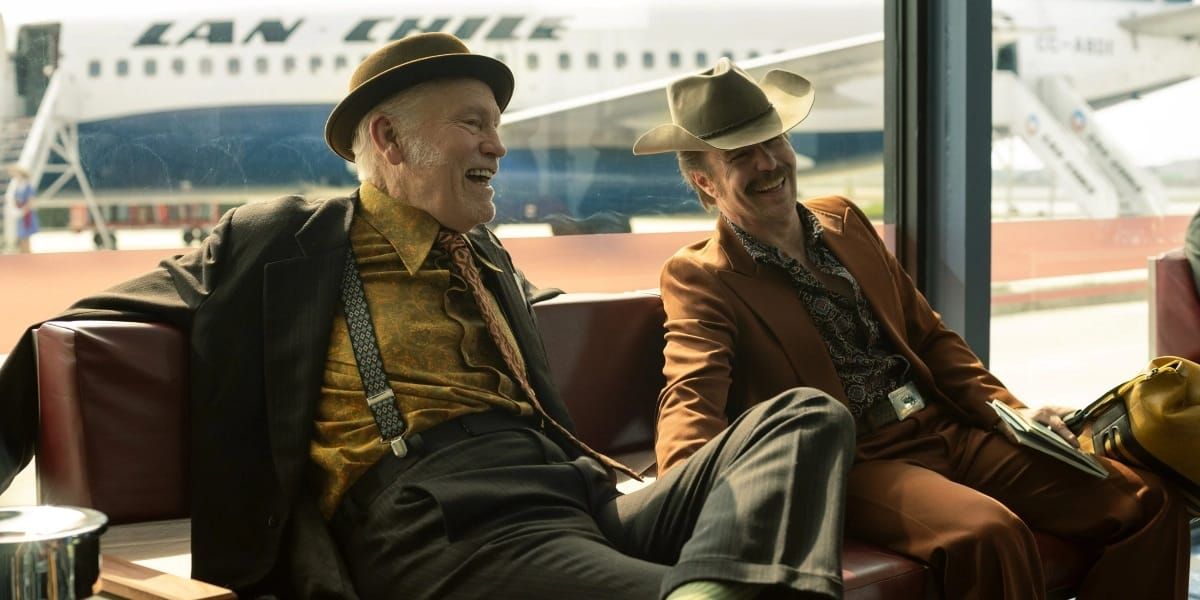
It's 1973. The military overthrow of Chilean President Salvador Allende, a coup in part aided by the United States government, is mere weeks away. Chris Carlisle (John Malkovich), a veteran CIA officer, is ready for a holiday. He's always dreamed of going to Rapa Nui, which he stubbornly insists on still calling Easter Island. Accompanying him is Lee Chesterfield (Sam Rockwell), his best friend and protégé. Chris has asked Lee to kill him on this trip to spare him a long and painful death from terminal cancer. Lee's also been tasked with killing Chris by M.J. (Steve Buscemi), their boss.
Martin McDonagh loves pitch-black comedy. The sourer, the better. His films and plays are defined by brutal punctuations of profanity, bad taste, and discomfiting revelations. They delve into the political in quiet ways, showing tales of corrosive conflict to backdrops of seismic change. McDonagh’s best work are prickly, fatalistic allegories of Irishness. He’s not so good when it comes to America. Three Billboards Outside Ebbing, Missouri, remains his most contentious film because of his fumbling of topics of race, which couldn’t shake the sense of an outsider talking about stuff he had no real knowledge of. Wild Horse Nine is an explicitly American story, but here, McDonagh is on surer ground. This is a story of imperialism, and the price of doing business in the name of "American democracy."
Chris might be the most powerful man on the planet. He's no mere jobbing killer. He's the assassin the CIA calls upon to bump off the big ones. It seems that he was responsible for murdering every democratically elected world leader on the planet over the past 30 years. Partly fuelled by a no-fucks-given approach to his impending death (and also morphine), he monologues about the world and his life, recording his musings for a future memoir. Now and then, he just outright admits to strangers that Allende's about to be bumped off. Why? Is it a cry for justice or one of defeat? What's the difference when you're going up against the CIA?
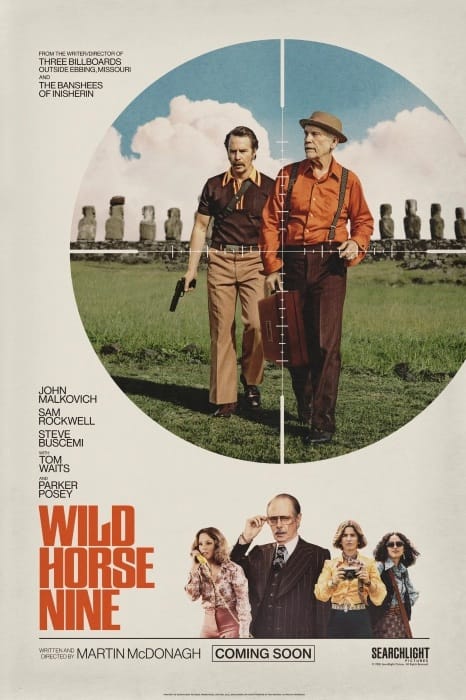
Malkovich gives the performance of his career here. Having won the Volpi Cup at the Venice Film Festival, he is surely a Best Actor frontrunner in this year’s awards race (although Andrew Scott and Elsinore are eagerly snapping at his heels.) He’s always been a unique actor with a frequently parodied kind of delivery I’ve seen referred to as “annoyed customer at the Olive Garden unsatisfied with his order.” It’s a diction that makes him seem mas though he’s out of time and space. Consider Dangerous Liaisons, where he should be all wrong for Valmont but his curiously contemporary wiles and almost accidental charisma make him impossible to ignore.
As Chris, he has only a few fucks left to give and is quietly giddy in how he fucks with Lee (which allows Rockwell to take on a rare straight man role.) He prods at his exasperated friend with the ease of someone who’s done it for years, but underneath is a real bond, one formed in the fires of their own hell. “Gallows humour” barely covers it when it’s your job to kill people. My favourite line, delivered with impeccable weariness by Malkovich: “You only have to taste American cheeses once to understand why we lost Vietnam.”
Being confronted with your own death after decades of ending others’ lives makes you wistful, but it’s also a deeply fatalistic experience that has left both Chris and Lee as emotional black holes. They feel like the cousins of Colin Farrell and Brendan Gleeson in McDonagh’s feature debut, In Bruges. Those men were also contract killers but small time, mere side players in an ecosystem of thugs and goons. While Malkovich and Rockwell are primed players of likeable rapscallions, their characters, by contrast, are cogs in a far more rotten machine. Democracy rises and falls by their hand, all in the name of the good old U.S. of A. They must view the world through a simplistic lens of good vs. evil in order to withstand the chaos and cruelty their work creates. It’s all very McDonagh-esque, that bleakly funny sense that maybe it’s all for naught. Laugh because the world will burn anyway.
But I’m not sure I’d call McDonagh a true nihilist. That would be too easy. He’s an Irish Catholic whose work is full of sinners who seek redemption, and by the tenets of that faith, nobody is beyond saving. Access to Heaven is a long shot for Chris, a man with a confessed body count of 68 and who admits in one revealing throwaway comment, "Sometimes I feel more concerned about the moths of Chile than the people of Chile."
There aren’t a ton of narrative surprises in Wild Horse Nine. The point is to see how Chris spends his final days, and whether or not he can conclude it all on his terms (ones he might have forgotten due to his memory issues.) Rapa Nui looks gorgeous here, a backdrop of indigenous pride and white tourist gawking for our American protagonists to once again play cops. Chilean actress Mariana di Girolamo shines as a college student and leftist who becomes a friend of sorts to Chris, even as he taunts her over the impending coup he's helped to orchestrate. Parker Posey turns up for two scenes and eats everyone's lunch, while Tom Waits gets one scene to remind us that he's an excellent character actor on top of being Tom fucking Waits.
Wild Horse Nine doesn’t live up to the brilliance of The Banshees of Inisherin, but it is a welcome refocusing of ideas on America from a writer-director who has struggled to find his footing on such territory. It probably helps that the U.S. government just keeps making this story ever more relevant with each passing year. Gallows humour, am I right?
Wild Horse Nine is in theatres now.