Review: Ballad of a Small Player is a Messy Letdown Despite Colin Farrell’s Best Efforts
Edward Berger's Macau-set drama can't decide whether it wants to be flashy or subtle.

Amid the bright lights and high rollers of Macau, the wealthy gadabout Lord Doyle spends most of his waking hours on the casino floors. His luck has well and truly run out, as his gambling debts mount and his seemingly endless line of credit is finally cut off. Left with few options, and with a private investigator on his tail, he is offered a lifeline by the mysterious Dao Ming, a casino employee with her own dark past. Taking it will mean confronting his true self, the one who keeps running away from his self-made problems.
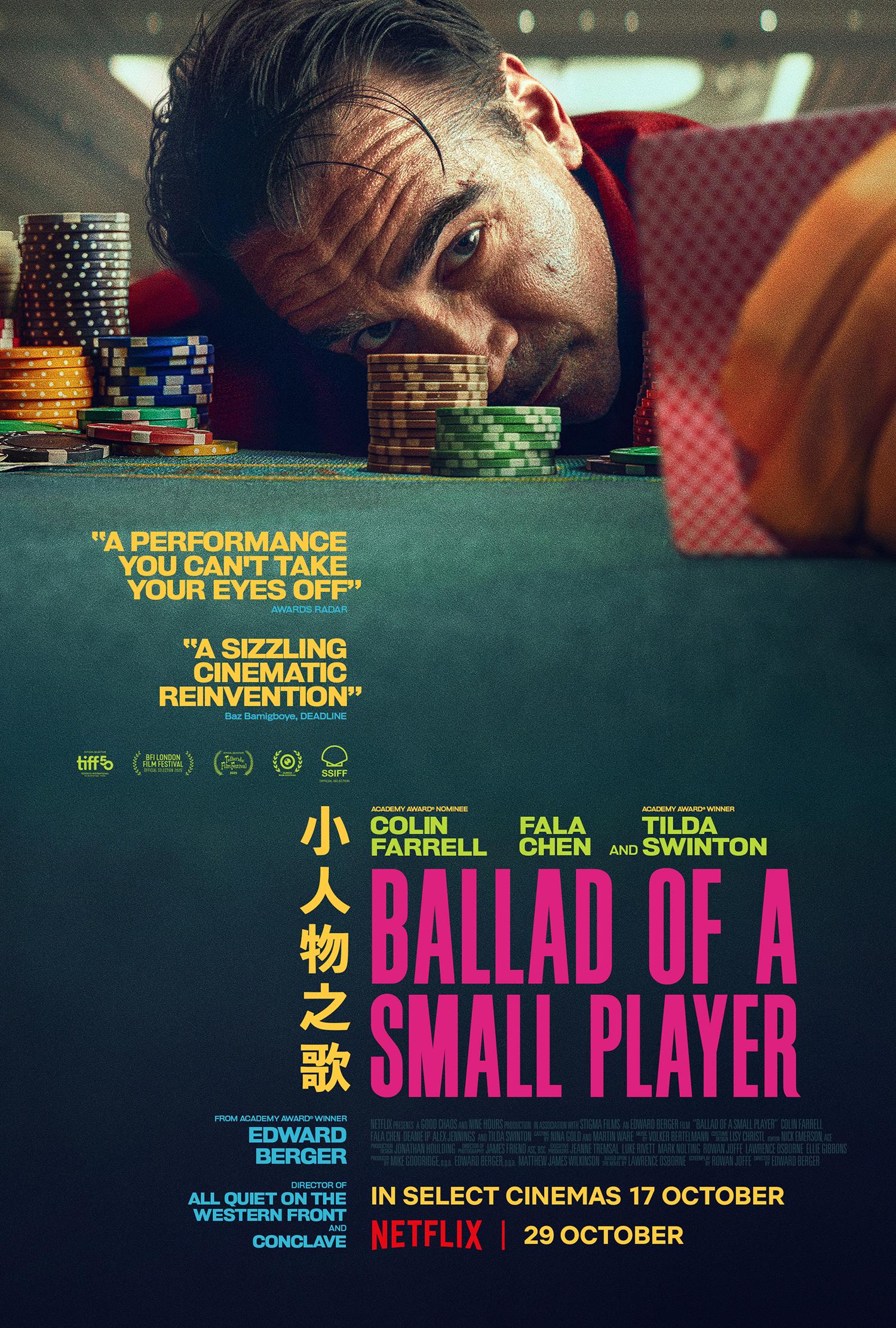
(I’ve been taking Chinese classes, and I just want to brag that I recognize two of those characters. Image via Netflix.)
While I was at TIFF last month, this was one of the more hotly anticipated titles of the festival season. It was director Edward Berger’s follow-up to Conclave and All Quiet on the Western Front, two big Oscar players that also became solid commercial hits. I remember sitting in the Conclave screening with minor expectations and hearing the press screening laughing and gasping along so excitedly. Leaving the cinema, I knew that one was going to be a big deal during the awards run. So the season goes: the follow-up to the Oscar winners is always destined to be described as a frontrunner, right up until people actually see it. While at TIFF, Ballad of a Small Player had its world premiere at Telluride, and suddenly that hype deflated like a child’s balloon. My reaction was somewhat similar.
Honestly, this might have been one of my biggest disappointments of TIFF 2025. It wasn’t a trainwreck or anything so spectacular, but I couldn’t escape the sensation that Ballad of a Small Player was a tad half-baked. Based on the novel by Lawrence Osborne, which I have been told is excellent and a far subtler narrative than its adaptation suggests, the film can’t seem to decide between obscene excess and existential angst.
Lord Doyle, it is quickly revealed, is not an English noble but an Irish scammer and compulsive gambler who has stolen millions from others and will do anything to keep his lavish lifestyle afloat. He gets away with a lot because he’s handsome, seemingly wealthy, and a white man in Macau where the high rollers are treated like gods. But that will only last for as long as he keeps the big tips and loan payments coming. Fala Chen plays Dao Ming, one of the many “brokers” haunting the sidelines of the baccarat tables, offering loans for desperate addicts but feeling trapped by her own lot in life. Alongside Doyle, they find some sense of solace, although the film treats it so ambiguously it veers into flimsy. Such is the tonal dissonance of the narrative overall.
This life he leads, we’re supposed to believe, is both spiritually empty and kind of awesome. Macau certainly looks stunning here, and even the most starkly lit casinos don’t seem as desolate as they could (compare this to Paul Schrader’s The Card Counter, where the gaming floors of Vegas feel like the world’s most depressing supermarkets.) I talked to a fellow critic at TIFF about the film and they joked that Edward Berger seemed to be trying to make his own Moulin Rouge, but with subtle layers about loneliness and the horrors of the class system at its heart (we also talked about how awful the needlessly loud and intrusive score is.) “Subtle” was never a term Baz Luhrmann was eager to embrace, and certainly, the bursts of flashiness in this film can look pretty impressive, but there’s no heft behind the bombast. That would be fine if the movie leaned into its own artifice, but it does seem eager to make the kind of dense thematic points that would feel more at home in an Andrew Haigh version of this story. These attempts to be meditative don’t work when you have Tilda Swinton hamming it up like she’s in a Snowpiercer sequel (or with a post-credits disco dance scene that reeks of “we want to go viral like Conclave did.”)

(Image via Netflix.)
That wobbly contrast between theatricality and contemplation also leaves us with no grasp on Doyle, as played by the always game and endlessly charming Colin Farrell. This dude is a full-on scumbag and thief who justifies his compulsion with Robin Hood-esque ideas about the acceptability of stealing from rich old ladies. As he slides further into the oblivion of debt, he gets sweatier and more desperate. In one memorable scene, he gorges himself, utterly without pleasure, at a luxury buffet, knowing full well he can’t afford to foot the bill. The film largely wants us to side with him, contrasting Doyle with another scammer (played by Alex Jennings) who can actually get away with his nonsense because of the privilege of his background. Still, it leaves the viewer dissatisfied. It’s only through Farrell’s performance that we are ever won over by him.
Thanks for reading Gossip Reading Club! This post is public so feel free to share it.
Edward Berger is a great journeyman who usually has his finger on the pulse of what the mainstream wants. Conclave works so well because he understood that you had to take this story just seriously enough, all while puncturing some of the pomposity with the occasional vaping cardinal or Ralph Fiennes reaction shot. Ballad of a Small Player tries to take on too much, and he feels spread thin by the time we get to the third act and a potential intrusion of the supernatural.
Ballad of a Small Player zips by pleasantly enough but offers none of the pleasures of Conclave or the punch of All Quiet on the Western Front. One imagines that Netflix will quietly push it aside in favour of its many other awards contenders this season. At least we got to see Colin Farrell with a super skeezy moustache.
Ballad of a Small Player is now on Netflix.