Oscar Seasoning: Marisa Tomei and the Legend of the “Wrong Name”
The My Cousin Vinny star has been the focus of an enduring Oscar conspiracy, but why?
The Oscars will forever be haunted by the La La Land/Moonlight Best Picture mix-up. An honest accident blew up into a live TV nightmare thanks to some inept accountants and an impatient Faye Dunaway, and it was truly astonishing to watch in real time. I remember it so well, sulkily doing the post-ceremony write-up then hearing the hubbub and gasping as though I’d witnessed a crime. But hey, it made for amazing TV. It became Oscars legend, of course, but it also inadvertently debunked a longstanding Academy conspiracy that plagued one actress for decades. No, they wouldn’t just let the wrong winner take the trophy home out of embarrassment.
I first heard about the Marisa Tomei conspiracy through an episode of Futurama, and as I became interested in the Oscars as a teenager, browsing sites like the IMDb forums and what was once known as OscarWatch, I encountered it frequently as part of awards season lore. Even back then, when I was a naïve dolt, I never bought this theory, and yet it prevailed for years. Why?
Picture the scene! It’s March 29, 1993, at the Dorothy Chandler Pavilion in Los Angeles. The 65th Academy Awards are taking place. Billy Crystal is hosting for the fourth consecutive year. Liza Minnelli sings a song called “Ladies’ Day.” The big winner of the night is Clint Eastwood’s Unforgiven, but the highlight is the long-awaited win for the forever-snubbed Al Pacino.
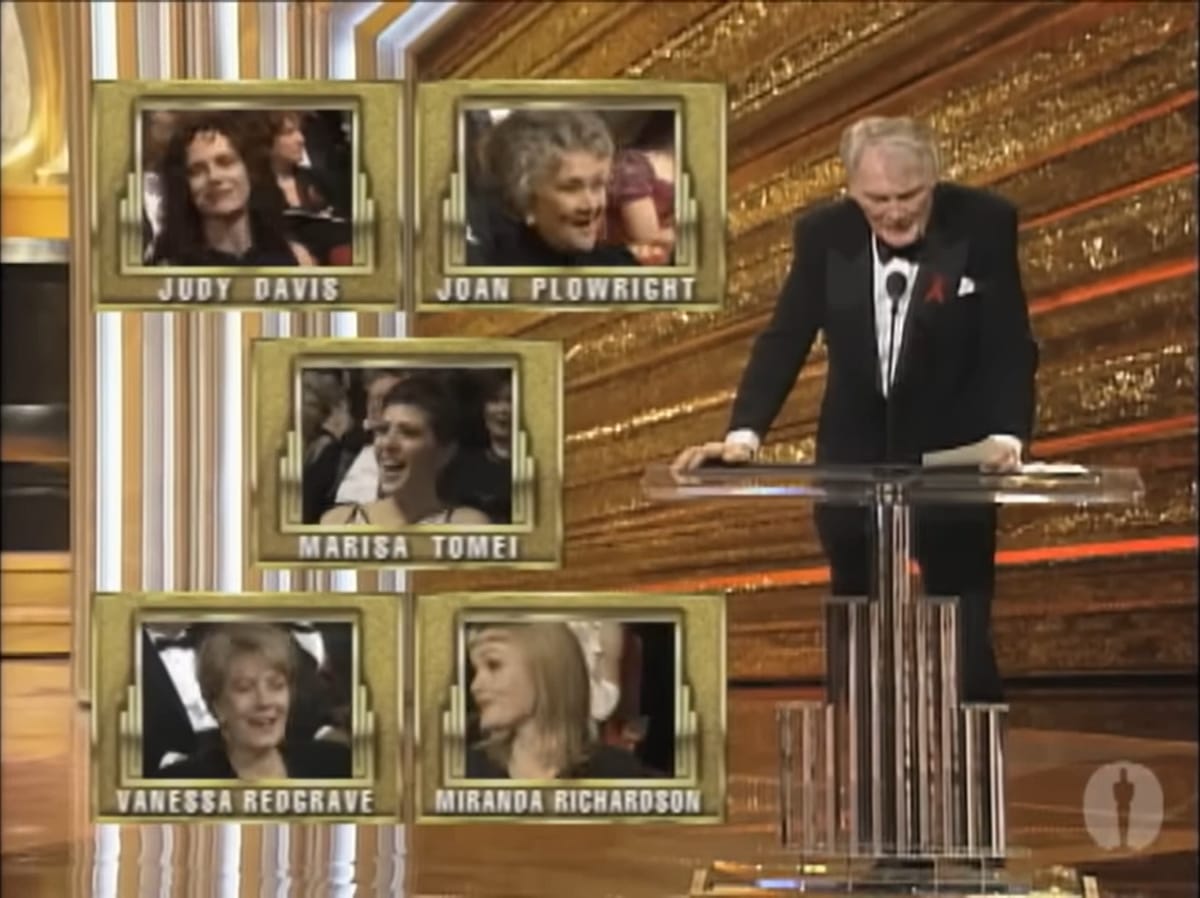
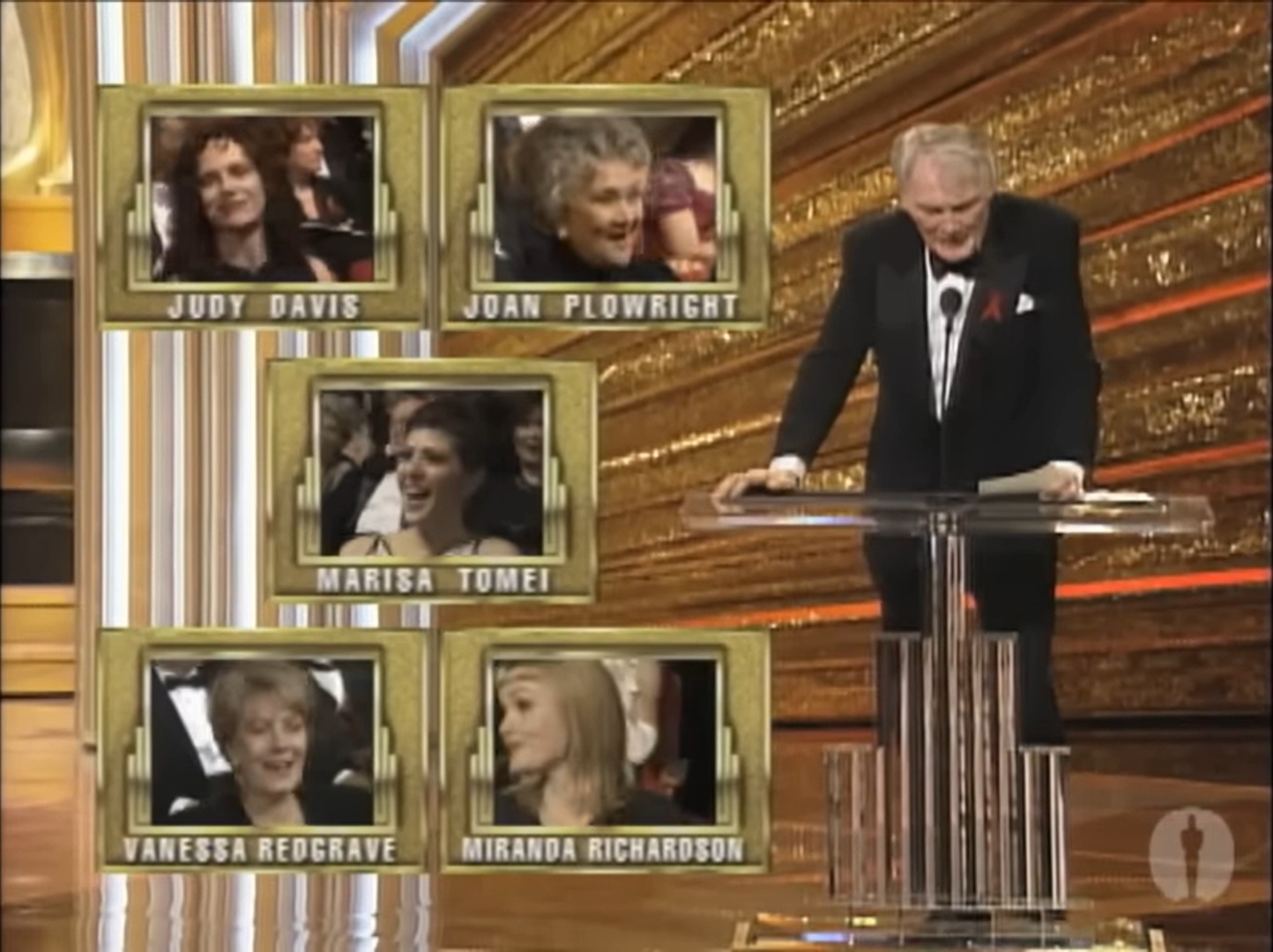
The surprise of the ceremony comes early in the night, when Jack Palance takes to the stage to present Best Supporting Actress. He works the crowd like a pro and makes a joke about how all the nominees are foreign: four from England and one from Brooklyn. The nominees are: Judy Davis for Husbands and Wives, Joan Plowright for Enchanted April, Vanessa Redgrave for Howard’s End, Miranda Richardson for Damage, and Marisa Tomei for My Cousin Vinny. And the Oscar goes to…
(Image via YouTube.)
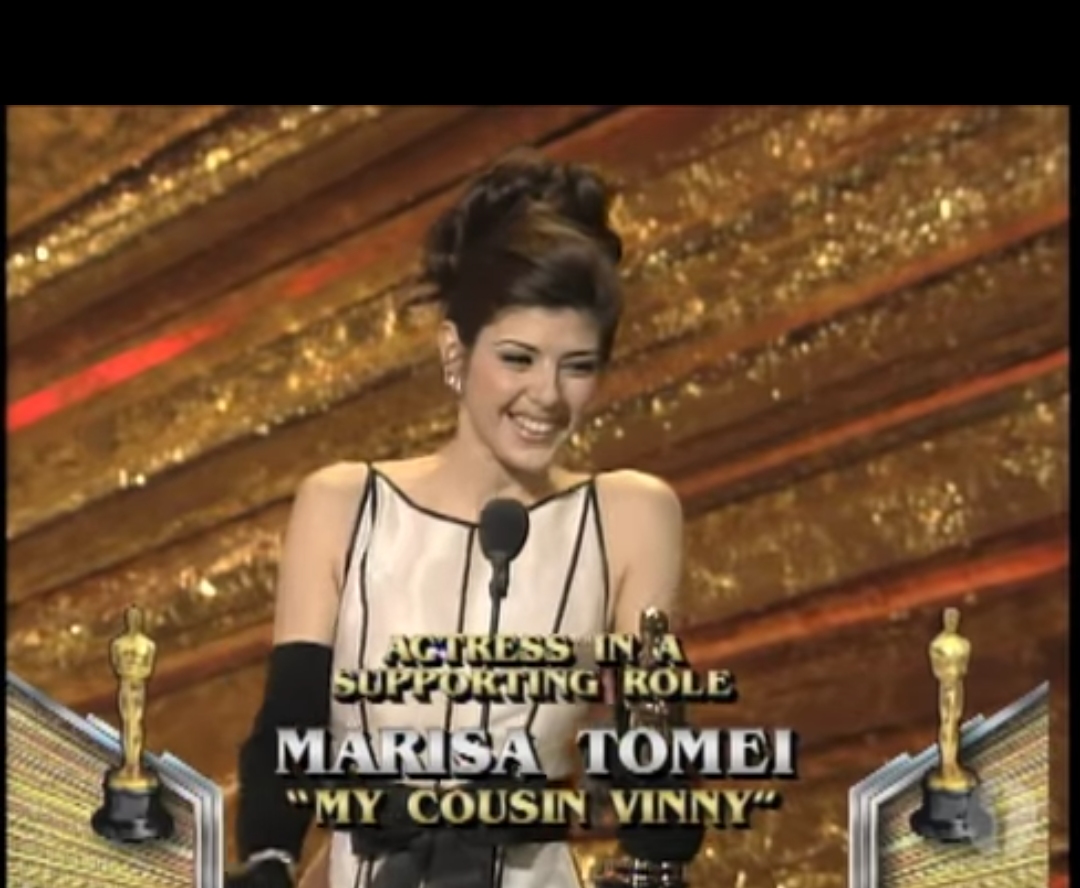
Marisa Tomei.
There’s a loud scream from someone in the crowd. Marisa looks shocked but delighted. Davis and Plowright seem surprised but happy. She gives a good speech, thanking her cast and team, and “my very brave family.”
It’s honestly a delightful speech and a great win. It didn’t seem all that weird either. Yes, Tomei was the newbie in a category of established stars, but the Academy loves an ingenue, and her film was a box office hit with crowd-pleasing appeal. Still, it wasn’t predicted.
(Image via YouTube.)
Dame Joan Plowright, the widow of Laurence Olivier and a stalwart of the British stage, had won the Golden Globe that season. Miranda Richardson took home the BAFTA for Damage, and she was also in two other big nominees that year: The Crying Game, one of the year’s most talked-about films and the eventual Best Original Screenplay winner, and Enchanted April, alongside Plowright. She won the New York Film Critics Circle award for the three movies she was in that year. Right behind her was Judy Davis, who had received some of the strongest reviews of the year for Husbands and Wives, winning the LA Film Critics Circle Award for her supporting turn. Vanessa Redgrave is a legend and a prior winner (and pro-Palestine icon) who was nominated for a Best Picture nominee. Crucially, all four of these women were in dramas, pretty hefty ones at that. Okay, Husbands and Wives is a comedy, but it’s also scathing about relationships and goes to some dark places. It’s also a Woody Allen movie, and for the longest time, he was the only comic director they acknowledged. By the standards of what we typically consider “Oscar-worthy performances”, these women seemed more likely to win it than Tomei. But she got it.
On Tuesday, March 22, 1994, the day after that year’s ceremony, The Hollywood Reporter printed a winners and losers piece that shared the rumour (via Gawker.)
“A rumor is currently making the rounds in Manhattan, fanned by no less than the former son-in-law of a distinguished Academy Award winner, to wit that last year Marisa Tomei received her Oscar statue by error, with a resultant scandal about it soon to be exposed, much to the shame of the Academy. (All of this quite erroneous, I hasten to add, but do read on.) According to the rumor, it happened because Oscar presenter Jack Palance hadn’t been able to read the name written in the secret envelope when he was on stage announcing 1992’s best supporting actress winner. Instead of asking for help, so sayeth the tale, Palance arbitrarily called out Tomei’s name instead of the actual winner. (Since the story is bunk, there’s no need to reveal the name of the lady who was/is being bandied as the “real” winner of that specific prize.)
It makes for provocative gossip, all right, but it didn’t happen. And for a good reason: When the Oscar ceremonies first went public on television back in 1953, Academy officials were aware of the possibility that one day some presenter might make such an error, either accidentally or for some mischievous purpose. So ever since then, at each and every Academy ceremony — including last night’s event, and the preceding year’s — two members of the accounting firm of Price-Waterhouse, the company that has tabulated the final Oscar ballots since 1935, are present in the wings during each Oscarcast. In the event a presenter should err in naming the correct winner in any category, said P-W official has been instructed to immediately go to the podium and announce that a mistake had been made. So Marisa, stand assured that Oscar is adamantly yours, no matter what rumor may sayeth to the contrary.”
See, it’s all nonsense. Alas, the Streisand Effect is a thing, and the story only gained more traction after this debunking. The Academy was forced to refute the rumours. Eventually, it became so endlessly repeated that Tomei and her team had to respond. She even joked about it when she guest-hosted SNL. And yet it became Oscars lore because it just seemed too juicy to put to rest. One such bitchy loser helping to keep it alive was Rex Reed, the longtime critic and stupid sexist dumbass. While appearing on Geraldo Rivera‘s show, because that man loves a trainwreck, Reed claimed that the blunder had happened because Jack Palance was drunk or high, and he just repeated the last name on the autocue, which was Tomei’s, and not the “real winner”, Vanessa Redgrave.
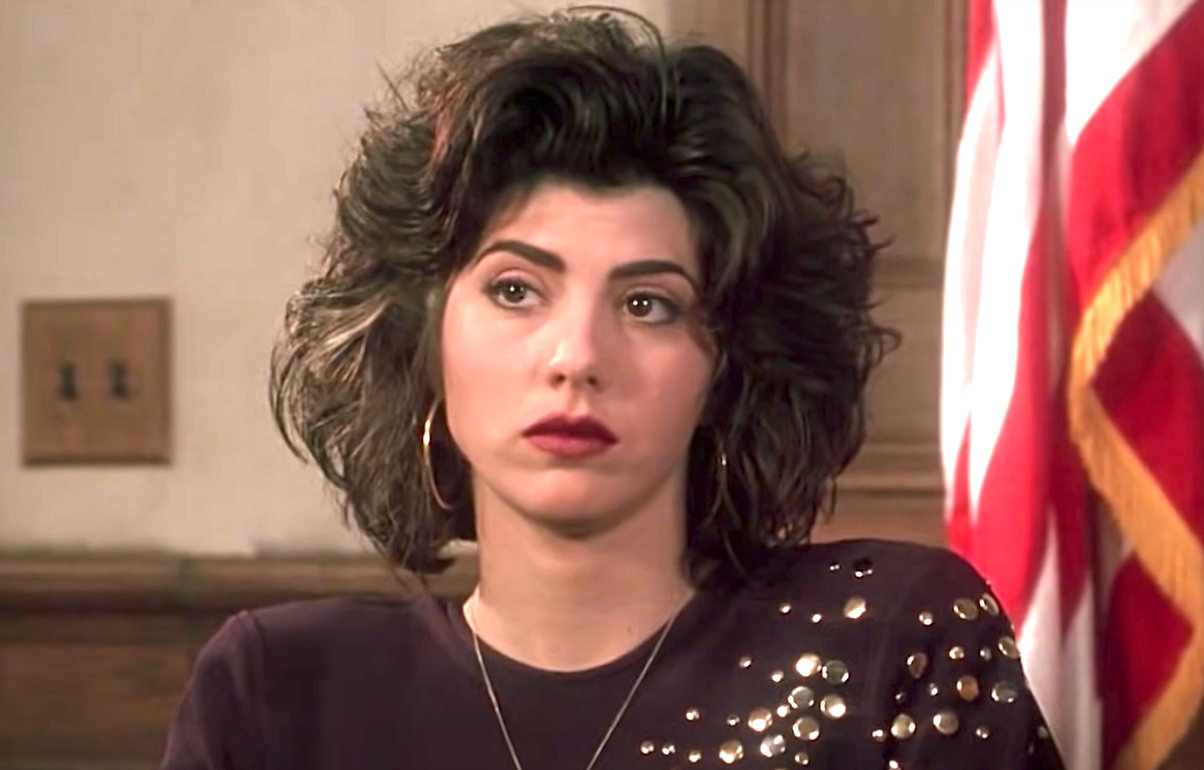
(Image via IMDb.)
It was the presence of Palance that seemed to make this rumour stick around. He was a 74-year-old man with a penchant for going off-script and ad-libbing. His joke about all the nominees being British except for Tomei was wrong because Davis is Australian (he also accidentally called her “Joan”.) The previous year, when he’d won Best Supporting Actor, he’d famously done one-handed push-ups. It didn’t seem all that odd that he would make an error. How much of this was rooted in ageism? All of it.
This rumour is so easy to debunk in the current age of instant replay. Watch that YouTube video of Tomei’s win, and Palance is clearly not reading off the autocue. He opens the envelope, takes it in, then announces Marisa’s name. It’s not like when Warren Beatty had the wrong Best Picture card and was clearly confused.
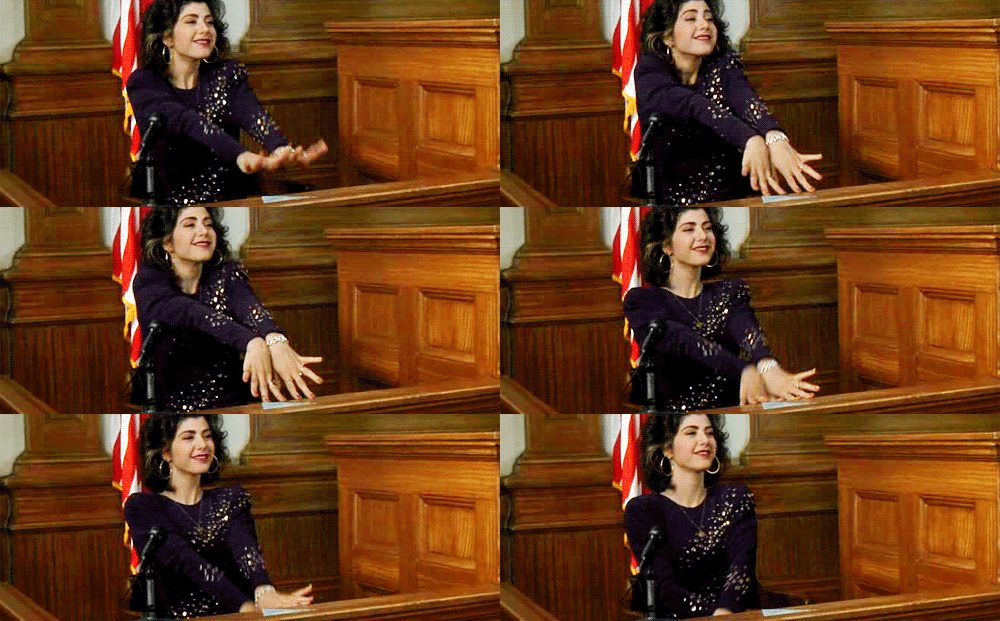
As you can imagine, the rumour was pretty hurtful for Tomei, who should have been able to enjoy this new peak in her career being accused of stealing it from some elderly British dame. All the gossip took away from the fact that she’s an absolute blast in My Cousin Vinny and is giving one of the great comedic performances of the ‘90s. As Mona Lisa Vito, the girlfriend of Vinny Gambini (played by Joe Pesci), she’s the sharp-as-a-tack and perennially underestimated heroine who steals every scene she’s in. When she takes to the stand to dismantle the prosecution’s case via her encyclopaedic knowledge of cars, it’s a powerhouse performance from a screwball queen.
Every critic adored this performance, even the ones who didn’t love My Cousin Vinny. And surely we should be encouraging of the Academy celebrating comedic performances? We don’t do it enough. But Tomei was young, a former soap opera actress, and doing a “frivolous” genre, so the snobbery was intense.
The film has stuck around, too. It’s surprisingly beloved by real lawyers because it’s incredibly accurate in ways most legal narratives aren’t. In America, it’s a big cable movie favourite, and drag queens the world over love Mona Lisa (“My biological clock is ticking like this! And the way this case is going, I ain’t never getting married!”)
Tomei obviously won in the long term. She landed two more Oscar nominations, this time for dramas (In the Bedroom and The Wrestler), she’s the newest Aunt May in the Spider-Man universe, and she’s done acclaimed work on stage. Mercifully, the conspiracy over her Best Supporting Actress win has died down, and the world has moved on (albeit to even worse conspiracies, but still.) If this case had gone to trial, I’m sure Mona Lisa would have dismantled it effortlessly.