Issue 33: Princess Diana Talks Back
A gossipy insider piece from Vanity Fair broke the illusion of the fairy-tale royal marriage.
The past few months have seen the British monarchy in a state of flux, the likes of which it hasn’t seen since the days of Edward VIII’s abdication. King Charles formally stripped his brother Andrew of his princely title as well as his many honours, and ordered him to leave his home at Royal Lodge. The man once known as the Duke of York will know be a normal citizen named Andrew Mountbatten-Windsor. This comes after years of scrutiny following Andrew’s open friendship with the late convicted sex criminal Jeffrey Epstein, and accusations that he sexually assaulted Virginia Giuffre, one of Epstein’s trafficking victims. Andrew has always denied these accusations, but it seems that not even his own brother believes him anymore. Add to that the many years of AMW’s dodgy business dealings, his schmoozing with dictators, and him being an all-round c*nt, and nobody is sad to see him go.
As a die-hard anti-monarchist and gossip writer, I have watched this unfold with not so much glee as optimism. Could this finally signal an end to this nation’s unbearable fetish for the royals? It has been fascinating to see people from across the political spectrum align in agreement with the fact that AMW is a skeeze and should be disposed of. Not even the most hardcore crown-f*ckers wanted to defend him. Alas, I don’t think we’re moving towards a republic any time soon.
Still, as Andrew packs his bags and moves into his new, slightly less fancy home, on his brother’s dime, it’s not hard to think about the ways in which the Windsors have been defined by the press and how they’ve used that to get their stories across. Queen Elizabeth II may have lived under the ethos of “never complain, never explain”, but the younger generations never followed that philosophy. Case in point…
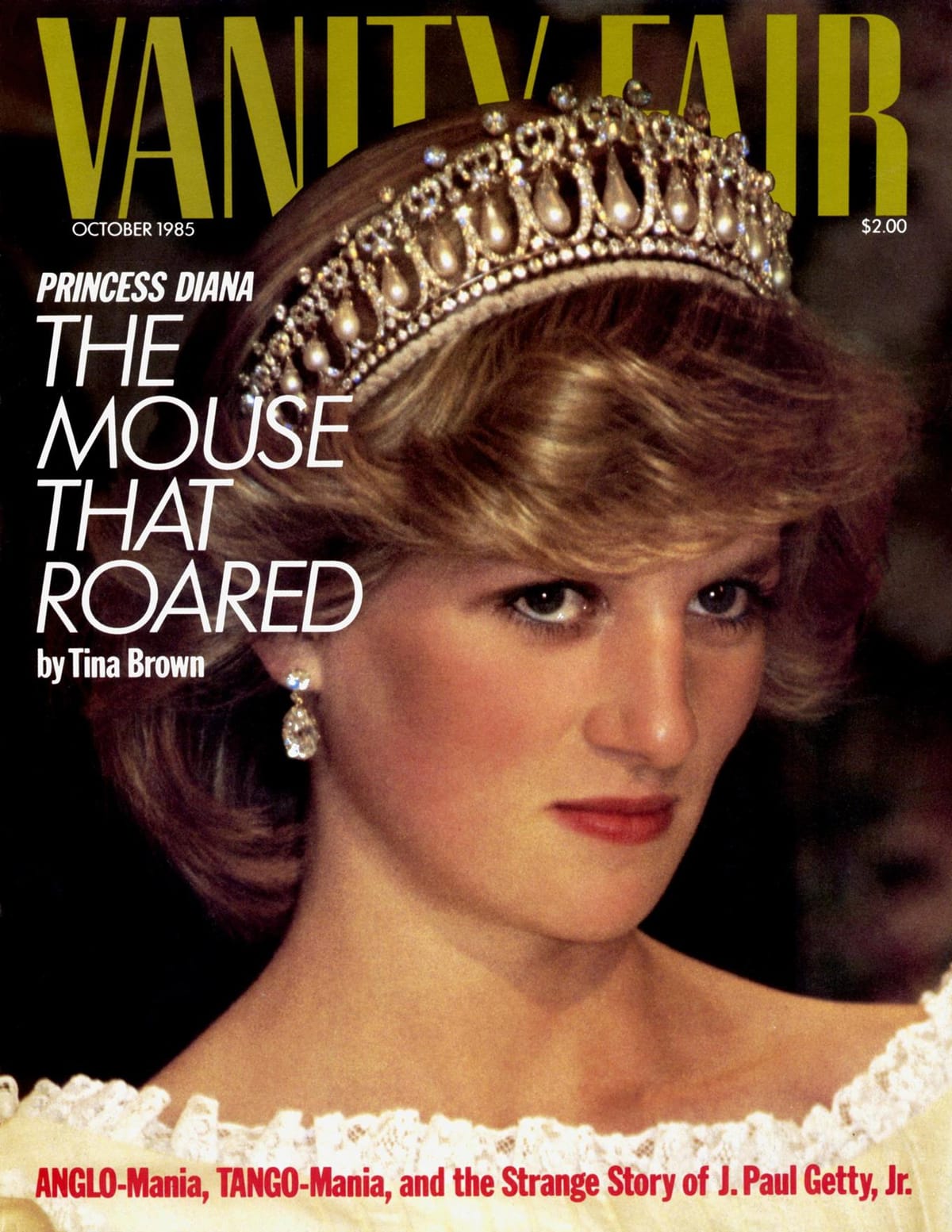
Vanity Fair. “The Mouse That Roared.” October 1985. Tina Brown.
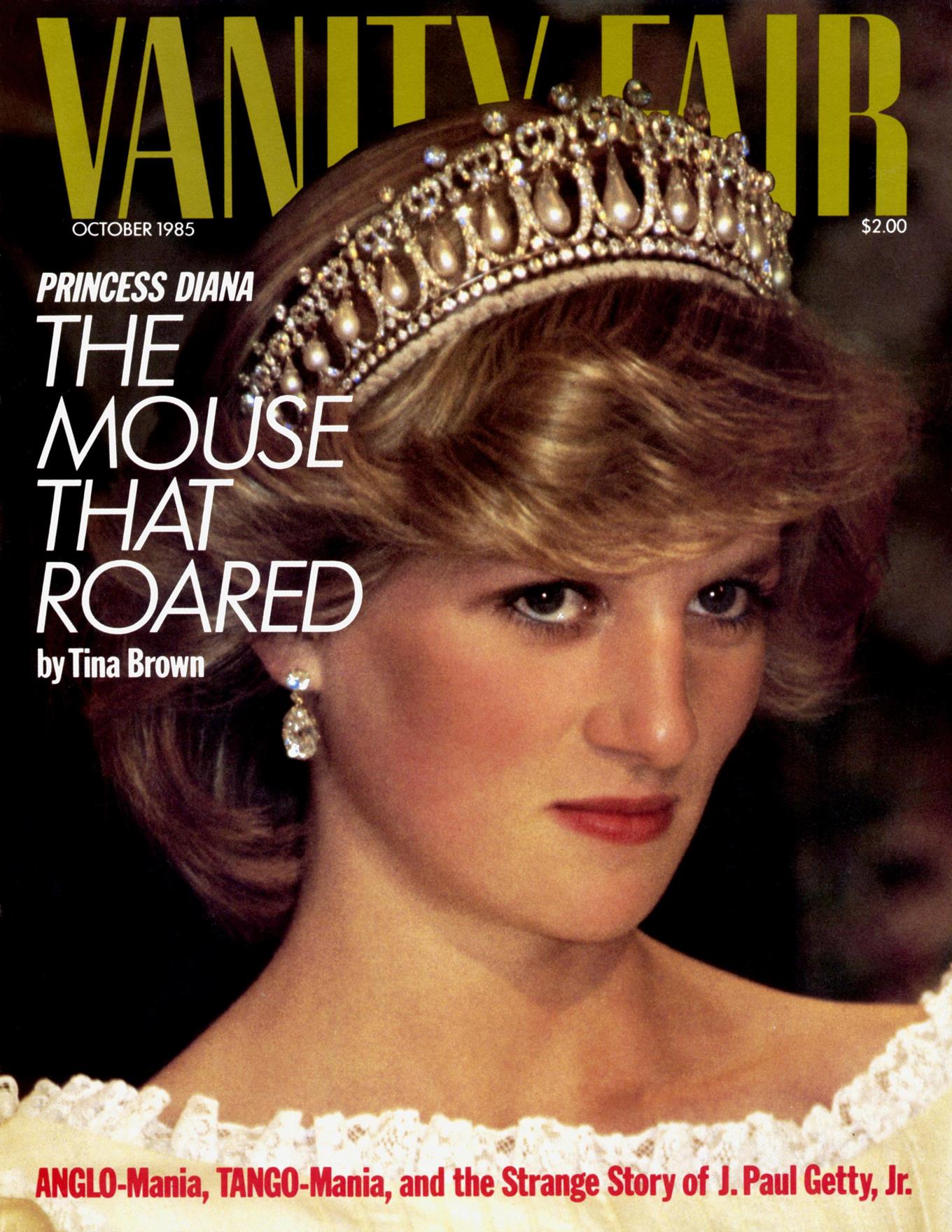
(Image via Vanity Fair.)
It’s easy to forget now, but before her death in 1997, the press and public were not stridently pro-Princess Diana. In the weeks leading up to the car crash that killed her, the tabloids obsessed over her private life, jet-set lifestyle, and seeming frivolities. A famous National Enquirer retraction captures the jarring shift in tone once she passed away, going from sinner to saint.
A love for Diana is something that unites people from all walks of life: royalists, republicans, queer people, old racists, drag performers, style bloggers, conspiracy theorists, and gossipmongers. She is invoked in 2025 to mock the Windsors, shame Harry and Meghan, force endless comparisons between other royal women, and stand tall as the ultimate cautionary tale of the dangers of the predatory press. For her entire adult life, as brief as it was, Diana faced a barrage of cruelty from both within the institution that was meant to protect her and the public that demanded everything. We talk nowadays of how well hidden much of her pain was, but, really, a lot of it was well known for years. The infamous Martin Bashir interview let Diana open up in a raw way, and there was the Andrew Morton biography that was written with her cooperation. But even in the mid-80s, amid the so-called honeymoon period of the Wales marriage, these stories were emerging.
In 1984, Tina Brown was made editor-in-chief of Vanity Fair, the legendary society magazine that had lain dormant for decades before being revived the previous year. Brown was a wunderkind of publishing, the daughter of a film producer who was expelled from three boarding schools and went on to become the editor of Tatler at the age of 26. She was barely 30 when Vanity Fair hired her, but she immediately put her stamp on the magazine, which she originally found to be “pretentious, humourless. It wasn’t too clever, it was just dull.”
She hired big-name writers and photographers, did headline-grabbing cover pieces, and brought a blend of high-low coverage that saw pieces on society murders and war reporting next to images of A-Listers adorned in jewels. In 1985, three massive stories helped to push Vanity Fair into a new level of acclaim: Dominick Dunne’s profile of Claus von Bulow, an accused murderer who posed for the magazine in his leather gear; a cover shoot featuring the Reagans dancing in the White House, and Brown’s own reportage on Princess Diana. Brown was a part of the high society scene of the UK and mingled with plenty of the upper classes in Charles and Diana’s orbit. To this day, Brown remains a popular royal commentator who has written a couple of books on the subject. It’s a good line of work for any journalist with a plummy English accent who went to private school.
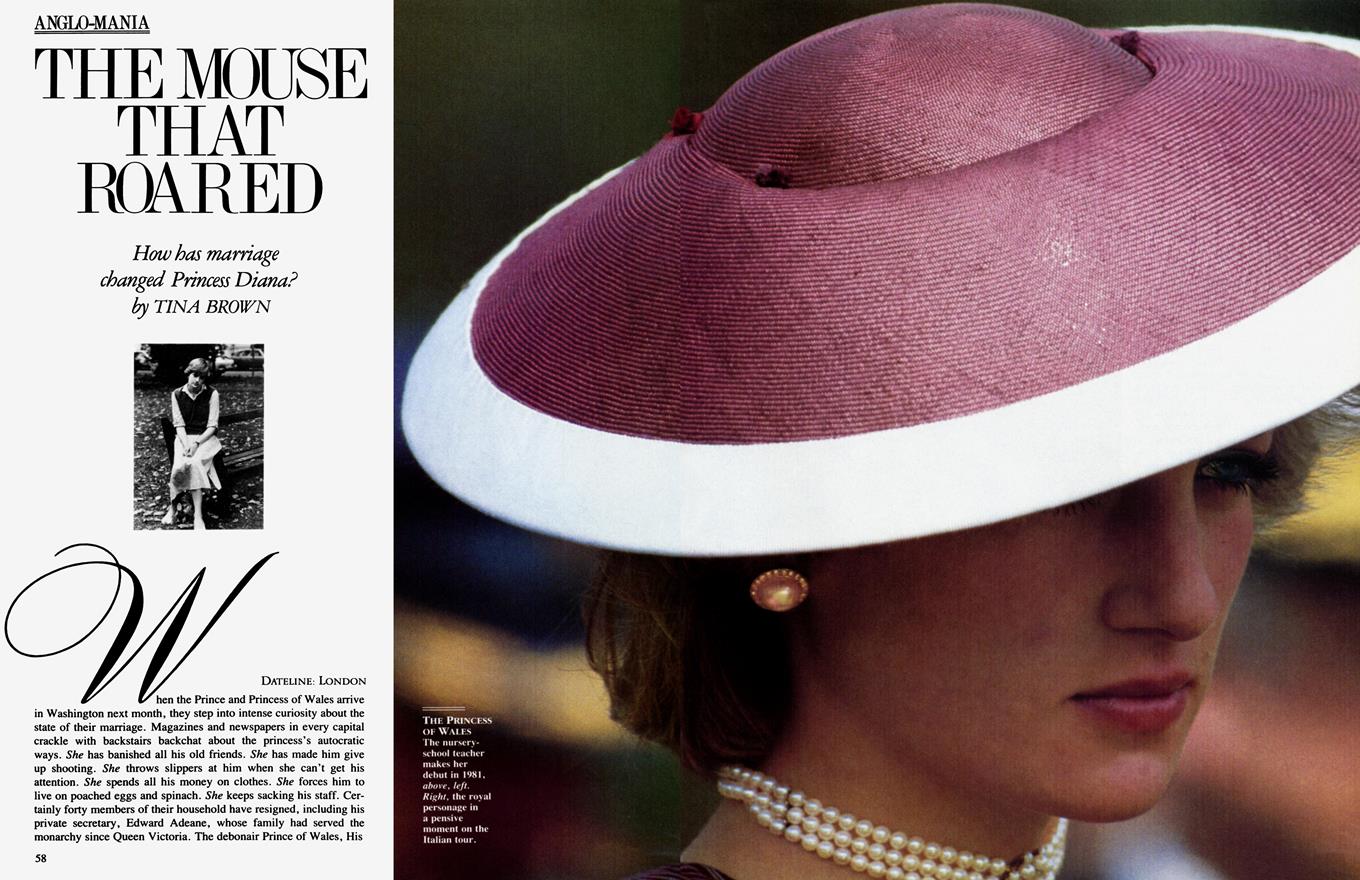
(Image via Vanity Fair.)
In her book, The Vanity Fair Diaries, written during her tenure at the magazine, Brown offers some details of the creation of this piece. Having heard whisperings that the Wales marriage was in trouble, Brown flew out to London to meet with some of her friends and old Tatler connections to figure out the story. The gist: Diana was a young ditz whose status as the new star of the family had made Charles jealous and insecure, but it also left the princess in a state of fear and emotional hell that led to her lashing out in big ways:
“It seems all that shy, youthful exuberance of hers is being transmuted into the stifled feelings of a caged butterfly, utterly unaware of the mechanism of her extraordinary appeal. She knows how to use it instinctively but is utterly uninterpretive of her life and fate, which is hardly surprising given how young she is […] The more she becomes a star on the world stage, the more Charles feels overlooked and withdraws into his melancholy inner life.”
Brown also writes that one of her biggest sources, Nigel Dempster, said that Charles hated “Diana’s total absence of intellectual curiosity.” Well, you did marry a teenager who, like many high society girls of that era, dropped out of school at 16. If Diana expected her prince to be a dashing hero, as Brown suggests, it’s hard to blame her. What were you like at 16?
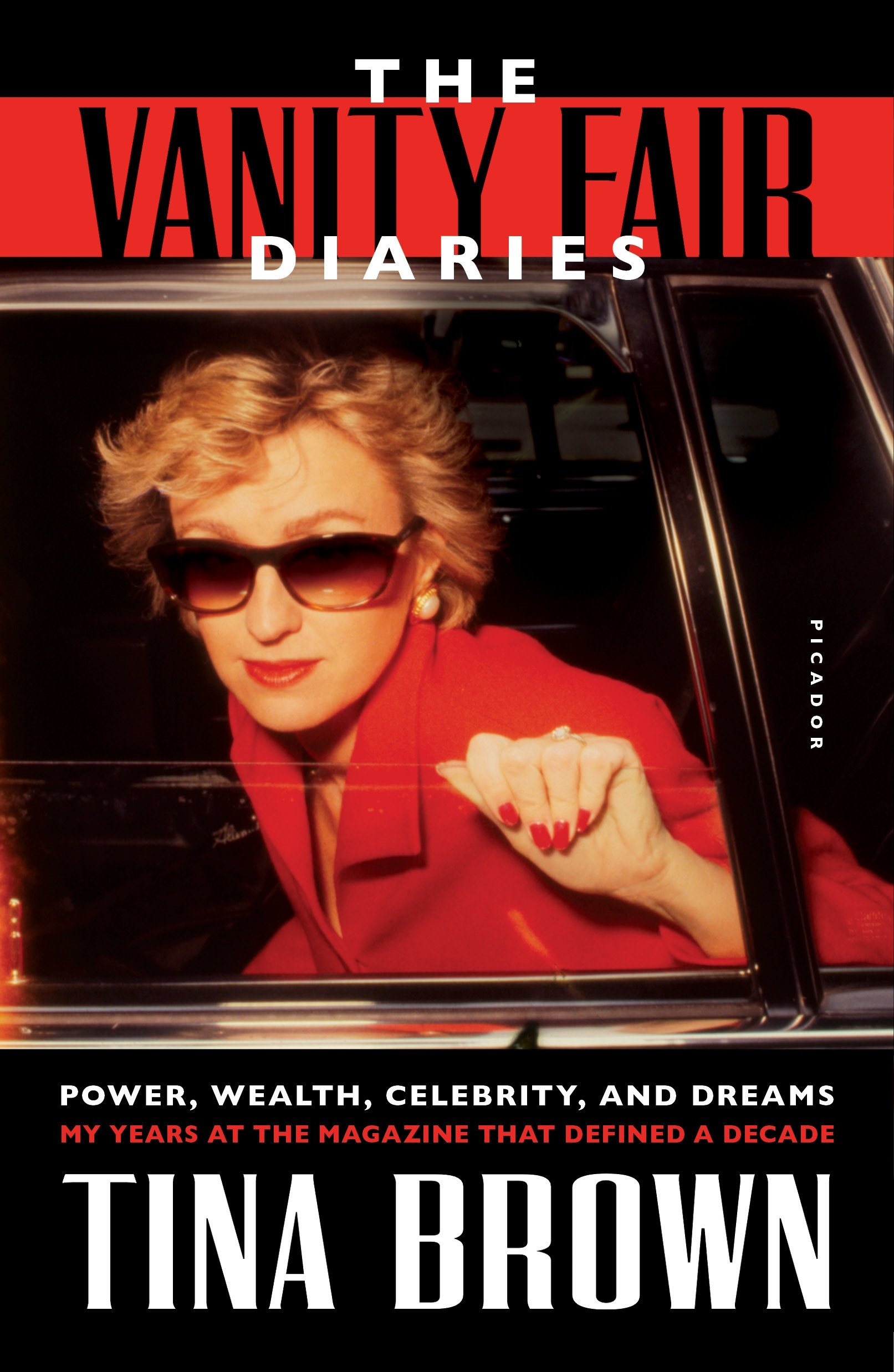
(This is a fun book, but it makes me sad that I wasn’t born in the era of cultural journalism where the industry had, you know, money. Image via Amazon.)
So, it’s interesting how Brown starts her Vanity Fair piece by noting the ways that the British royal ratpack has descended upon the still-heartbreakingly young princess and her “autocratic” ways:
“She has banished all his old friends. She has made him give up shooting. She throws slippers at him when she can’t get his attention. She spends all his money on clothes. She forces him to live on poached eggs and spinach. She keeps sacking his staff [...] The debonair Prince of Wales, His Royal Highness, Duke of Cornwall, heir to the throne, is, it seems, pussy-whipped from here to eternity.”
Yes, the use of that term was controversial. Ben Bradlee, the legendary executive editor of the Washington Post, told her he’d never put it in his paper because it was a family publication (which also falls right in line with something that happens in All the President’s Men.) It was seen as too gauche for a classy publication like Vanity Fair, and perhaps too British a vernacular for sensitive Yanks. The misogyny of the moment didn’t seem to get called out as furiously.
Diana, it seems, went from being a timid country mouse to a panic-attack ridden princess finding solace in the glow of celebrity. But she’s also not unique in that regard, so details Brown.
“While he withdraws into his inner world, his wife withdraws into her outer world. Her panic attacks come when she is left alone and adulation-free on wet days at Balmoral; his come when his father tells him he must stop being such a wimp and behave like a future king. What they share is an increasing loss of reality. Ironically, both are alienated by the change in the other.”
This friction requires deeper analysis. For Brown, the conflict between the Wales couple is a land of contrasts. Pre-marriage, Charles as “Action Man”, beloved by the ladies but “a lonely, eccentric figure haunted by self-doubt” on the inside. He liked rebellious women who were decidedly un-princess-like. After dating a “reckless horsewoman” with the fabulous name of Anna “Whiplash” Wallace, Charles apparently realized that he needed to “snap up the shy little sister of his friend Sarah Spencer because the chances of another eligible virgin coming his way were slim.” Everyone thought it was a good idea, from Charles’ mother to the press to Diana’s family. If he didn’t pick the younger and naive woman who is derided as “not very bright” then Charles would “find himself like a royal Roman Polanski dating thirteen-year-old girls when he was forty.” Yeah, the “yikes” counter is going to be high on this issue, guys. Sorry.
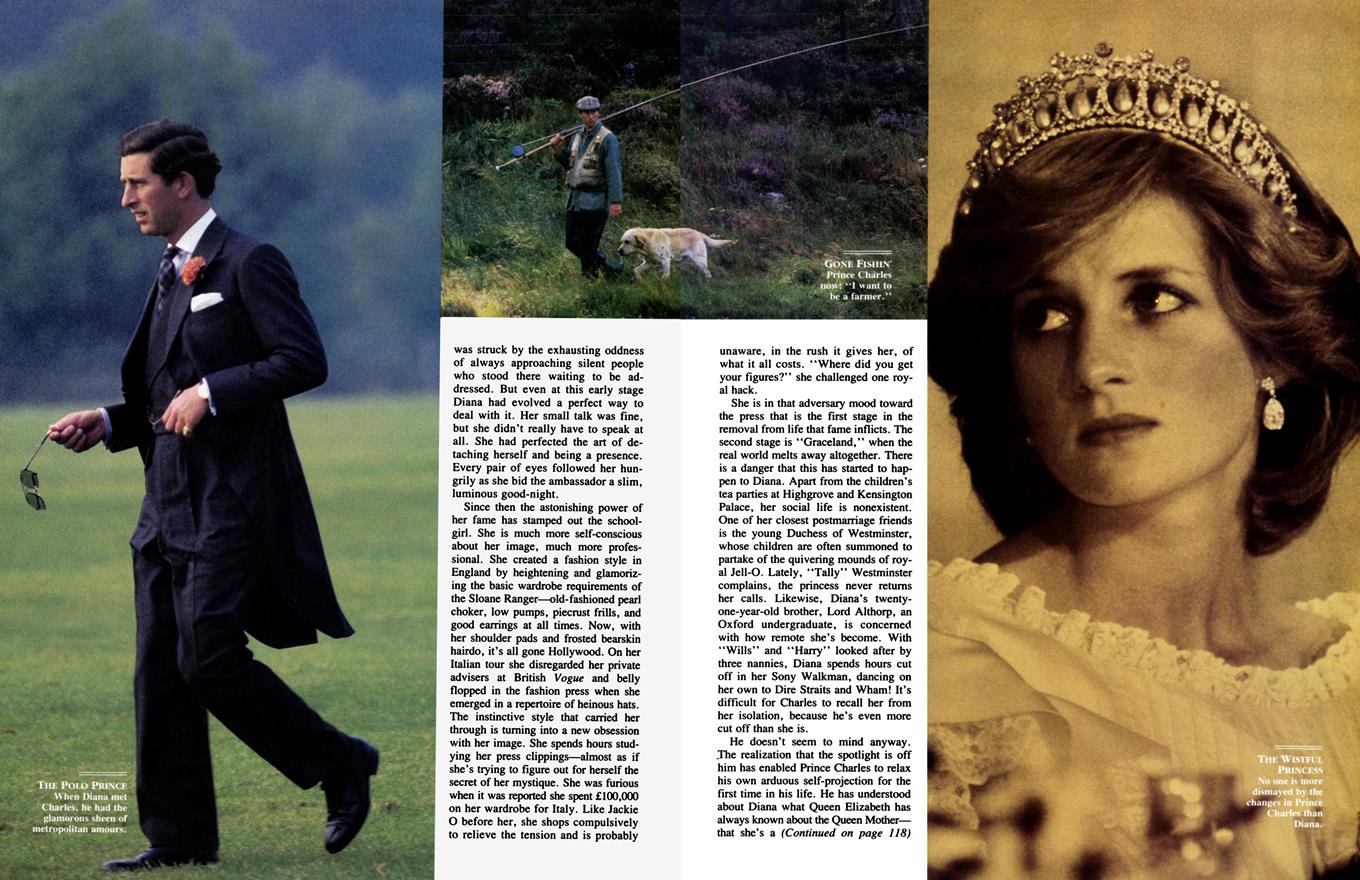
(Image via Vanity Fair.)
Camilla Parker-Bowles, by the way, is only mentioned by name once, as one of his two exes who “had met the blushing little Spencer girl and deduced she was not going to give them any trouble. Better her than another fiery number like Anna Wallace.” I wonder how much Brown knew about Charles and Camilla’s affair, which didn’t end for a second once Diana entered the scene. She was enough of an insider to know what the biggest open secret was among the royal set. Was this seemingly throwaway line her hint towards the more nefarious scheming going on behind the scenes? Or is this projection on my part? Answers in the comments, please.
Thanks for reading Gossip Reading Club! This post is public so feel free to share it.
Brown is remarkably candid in calling the marriage what it was: an arrangement pushed by an institution onto a tired brat who didn’t let the other party in on the details. As Diana herself would note later in life, she was the only one who thought it was true love. This candour sees Brown offer some sympathy towards the still-young and obviously trapped Diana, but not wholeheartedly so. The moments that prove most intriguing in this piece are the tidbits of first-hand experiences with Diana that Brown shares. Unlike a royal reporter, Brown usually met her on relatively equal social standing. She got to see, unfiltered by cameras or headlines, her charm and “the art of detaching herself and being a presence.” It’s a quality that Charles seemed to lack.
(Side story: My mum grew up around posh people who moved in some royal circles, and they said Charles was very kind and funny. Philip and Andrew, on the other hand, were exactly as you expect.)
Diana’s lonely life is shown as pitiful but also partly her fault. She’s painted as an obsessive shopper who’s too focused on her image, even though it was something that was talked about constantly. Her “adversary mood toward the press” is compared to Graceland, tilting towards a mindset “when the real world melts away together.” She is “permanently on a diet”, a possible reference to her eating disorder. The idea of Charles being a farmer and househusband rather than the “James Bond smoothy with a glamorous sheen of metropolitan amours” she thought she married horrifies her. Life as a royal is rather boring, devoid of anyone in her age group and mostly populated by “hoorah Henrys” she (understandably) cannot abide.
I don’t think the piece is wholly anti-Diana. It’s clearly pieced together from an assortment of sources and insider voices who seem more inclined towards the upper-class status quo than anything too left of right. That’s still Diana’s circle but the inner part is so tight-knit that it makes even her an outsider. So, we get a portrait of, to put it bluntly, a little girl: petulant but also thrown into the lion’s den with no warning. And it hasn’t made Charles any happier. We know that he didn’t want to marry a younger nursery teacher with whom he had nothing in common, and that he never stopped being in love with the woman who is now the Queen. Later in her book, Brown speculates that Diana is leaking stories to the press to paint Charles as a villain, and that he has no way to respond to that (sure, okay.) There is sympathy for him here, perhaps because nobody was quite ready to expose his affair or how tormented Diana truly was during these years. Hindsight and all that.
“Gossip can be powerful,” said Brown in 2017 when she was asked about this profile by CBS, where she was a contributor. Many years later, when she had dinner with Diana, post-divorce and in her revenge dressing era, the princess told Brown that everything in the story was true.
The piece caused much controversy, which Brown also details in her book. The Daily Mail tried to recast Brown as the bitchy controller of her “pussy-whipped” husband to claim her hit-piece was pure projection (Brown was married to Harry Evans, a legendary newspaper editor who reportedly left his wife for her.) Brown found this to be hilarious and framed the piece to hang in her bathroom, which is objectively a boss move. Messing with the royals was a no-go for the tabloids, and still is to some extent. Even now, as the country undergoes an immense shift in royal perspective following the exit of Andrew, it hasn’t opened up a more candid cultural critique of the Windsors. The headlines still fawn over William and Kate while painting Meghan as the villain of the century.
About a year after this piece, Vanity Fair wrote a fawning cover piece on Sarah Ferguson, then the Duchess of York, positing the idea that she would be the new star of the royal family because she was so much more outgoing and personable than Diana. Obviously, hindsight is 20/20 and reading any article on the gloriousness of Jeffrey Epstein’s BFF will make you cringe. Still, it’s another reminder of how Diana was forever forced to fight an uphill battle. Sometimes she won, like with the revenge dress, but largely, she was stuck with the undesired title of “acceptable punching bag.”
It’s hard not to think about Meghan Markle while reading this piece. There is always a “source” ready to make you pick sides, a courtier with a job to do. While I was researching this piece, the press was picking at the scab of Meghan’s relationship with her estranged father, who is currently ill and apparently being accompanied everywhere by a Daily Mail journalist. Not creepy or invasive at all. The piece also just made me think a lot about the royal ratpack and the business of being a commentator on this ridiculous institution. It requires a level of kayfabe that puts wrestling to shame, seen less as journalism than stenography dictated by palace sources. Maintaining the delusion that a royal family is necessary in the year 2025 is a full-time job of ceaseless spin, because with each passing year, and new scandal, we’re reminded that it’s all too easy to point out that we truly don’t need them.
Certainly, royal coverage has been good business for Brown. As she’s moved from publication to publication, from paper to internet, and now over to Substack, she’s remained front and centre in Windsor-related news stories. She’s dinged Prince Harry for being thick (fair) and posted some “just asking questions” shtick about Virginia Giuffre’s reliability as a victim before she died by suicide. The latter part ended very quickly after Giuffre’s passing, and Andrew became persona non grata.
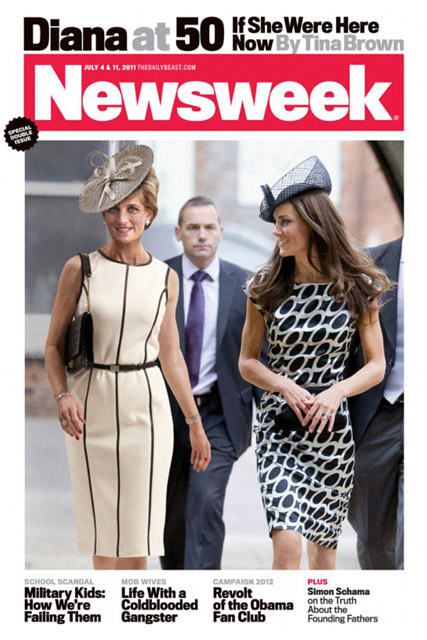
(Presented without comment.)
The piece ends with a note of, if not outright optimism, then at least a call for hope:
“It is somehow typical of Prince Charles that he was a yuppie when everyone else was a yippie, and now that everyone else has gone straight he’s discovered the flower child’s concern with brown rice and spiritualism. He’s in just the kind of mood to fall in love with a nursery-school teacher in flat shoes who’s kind to guinea pigs and babies. If he looks hard enough, she’s still there.”
Well, we know how it ends.

Thanks for reading. You can find my work scattered across the internet. Over on Pajiba, I wrote about the potential end of the influencer era, why Duolingo sucks now, and the rise of BookTok’s favourite thriller writer, Freida McFadden. I was on CBC Radio to discuss Club Chalamet and the perils of parasocial and gamified fandom. For The AV Club, I talked about Hamnet and the music that makes its ending.
If you’d like to sign up for a paid subscription to the Gossip Reading Club but don’t want Substack to get any of the cash (understandable), message me, and we can set it up manually. If you’d just like to make a one-off donation to this dog and pony show, and help keep the lights on/fund my ice hockey tickets, I have a Ko-Fi account!
This’ll be the last proper edition of the Gossip Reading Club for 2025. Thank you so much to everyone who has read, shared, and supported this newsletter. We just passed 3000 subscribers this month, which is truly wild and too large a number for my brain to hold. I cannot fully express what your support and enthusiasm mean to me. I hope you’ll stick around for 2026 as we head into yet another Oscar season!