Issue 31: The Introduction of Britney Spears (and The Crafting of Her Image)
Everyone remembers the Rolling Stone cover, but what about the profile?
Last month, former backup dancer and full-time scrub Kevin Federline released his memoirs. While he tried to claim that the book was not a desperate attempt to cash in once more on his ex-wife, Britney Spears, nobody believed him. The mercifully brief read, published by a company nobody has heard of with a seriously janky website, did not sell well. Critics who did read it weren’t kind either (see the Fug Girls’ writeup for more on that.) The tide had fully turned in favour of Spears after many years of treating her as a trainwreck and punching bag following one of the most tragic public breakdowns in celebrity history. Once upon a (one more) time, Federline probably could have made big bucks with a sleazy tell-all that shamed his ex’s struggles with mental illness, but blessedly, we’ve moved on from that.
It was, for too long, societally acceptable and expected for people to deride, shame, and parody Spears. The former Mickey Mouse Club performer turned teen pop superstar was always an easy target, long before she ended up in a stifling conservatorship that robbed her of her legal autonomy got 13 years. She was simultaneously an object of leering adult fetishization and puritanical scolding, both the symbol of a bright new age and the harbinger of its doom. This teenage girl was expected to be so much to so many, and it took us a whole generation to truly dissect the damage it caused. And it was there from the beginning of her rocket ride into the stratosphere.
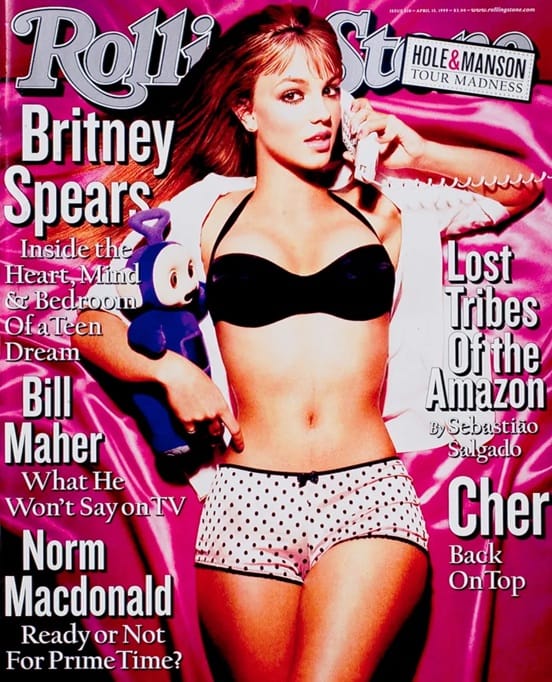
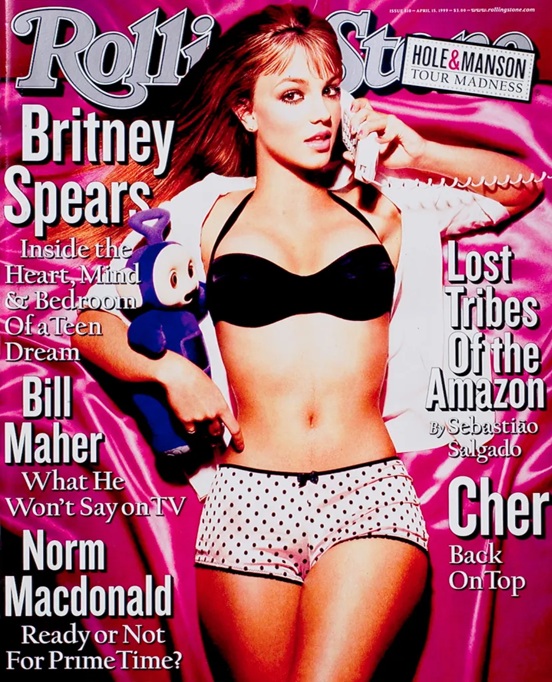
Rolling Stone. “Britney Spears, Teen Queen.” April 15, 1999. Steven Daly.
(Image via Rolling Stone.)
A lot happened in the Spring of 1999. The Kosovo war raged on, with NATO planes repeatedly bombing ethnic Albanian refugee convoys. The Columbine massacre took place, resulting in the deaths of 16 people, including the gunmen. Shakespeare in Love won Best Picture over Saving Private Ryan. At the beginning of the year, a 17-year-old from Louisiana named Britney Spears released ...Baby One More Time, her debut album. The title single has already been a number one hit on the chart, and the album was expected to do big numbers. As of 2025, it has sold over 25 million copies worldwide, making it one of the best-selling albums of all time (that’s more than Slippery When Wet by Bon Jovi and Purple Rain by Prince.)
Expectations were high for Britney, a child star who was entering the music scene at a time when the boyband ruled the roost. The biggest-selling album of that year would not be Spears’ but Millennium by the Backstreet Boys. Spears’ launch was inextricably tied with the success of that band, with whom she shared a manager and label. Every version of her album that was released before Millennium contained previews of three BSB songs as hidden tracks. She didn’t approve of this move but it was a sign of how eager Jive was to make her the next big thing. By the time this Rolling Stone story dropped, Spears was most of the way to fulfilling that potential. And so began a cultural tightrope walk to make teen sexuality a mainstream brand in the new puritan age.
Here is how the piece begins: “Britney Spears extends a honeyed thigh across the length of the sofa, keeping one foot on the floor as she does so. Her blond-streaked hair is piled high, exposing two little diamond earrings on each ear lobe; her face is fully made-up, down to carefully applied lip liner. The BABY PHAT logo of Spears’ pink T-shirt is distended by her ample chest, and her silky white shorts — with dark blue piping — cling snugly to her hips. She cocks her head and smiles receptively. But hold on. It’s not like that.”
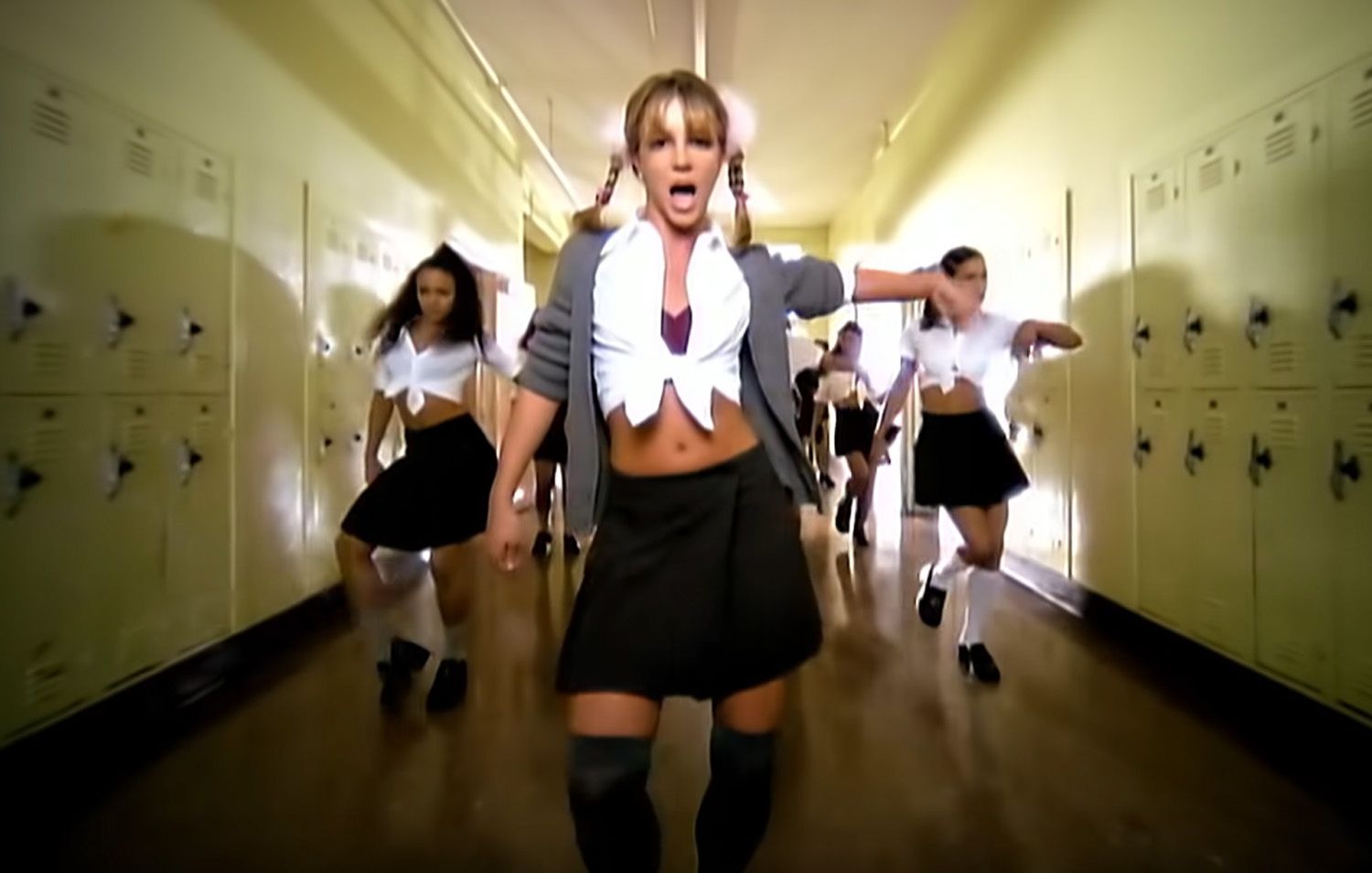
See, the writer isn’t really leering at and sexualizing a teenage girl. He’s just noting how the 17-year-old Britney is setting a trap that “carefully baited by a debut video that shows [Spears] cavorting around like the naughtiest of schoolgirls” without showing that much bare flesh. So, it’s totally okay for the adult writer to talk about her “ample chest” and “honeyed thigh.” He’s not the creep here, and how dare you even insinuate that!
(Admit it, you know all the words. Image via YouTube.)
We’ve been here before with profiles like this, displays of pure gawking misogyny that try to dress up their icky observations as serious reportage. The infamous Esquire piece on Jessica Biel tries to be self-aware about its drooling obsession with its subject but fell into serial killer territory with its rhetoric. Rolling Stone had fallen into this trap only a couple of years prior with its profile of Alicia Silverstone, which opened with a line about the teenage girl being someone who lots of grown men wanted to have sex with. “Ew” doesn’t even come close to conveying how gross this all is, right?
Britney is at the beginning of her career here, interviewed from her childhood home in Louisiana, following a dancing injury. She’s surrounded by her family, who are portrayed as loving and devoted to Britney but also down to earth and helping her keep her head screwed on tightly. Rolling Stone posits this piece as a chance for fans to get to know the real Britney beyond “the fan-mag prose” and “an image that hints at several stereotypes. Is Spears bubblegum jailbait, jaded crossover diva or malleable Stepford teen? Who knows? Whether by design or not, the queen of America’s new Teen Age is a distinctly modern anomaly: the anonymous superstar.”
Yes, reading all of that in 2025 feels really grim thanks to the curse of hindsight, why do you ask?
The era of Britney quickly became synonymous with the new era of adolescence as a super-force. As the profile notes, the late 90s felt like the revival of the 1950s, when the teenager was born and their immense cultural and spending power reshaped entertainment to their tastes. Instead of Elvis, we had boy bands, but the commodification of this demographic led to an industry-wide push for “safer” role models that wouldn’t corrupt those horny young minds. Enter the Mouseketeers. Same as it ever was. But the ‘90s were also the tail-end of the Clinton era, the post-Lewinsky period of Republicans screaming “family values” at every opportunity. Hollywood was retreating from its previous phase of erotic thrillers as the promise of a new age under the NC-17 era proved dead on arrival. The new needle to thread was one of wholesome filth, of PG-13 sexiness that skewed young and sold well.
So, when this piece describes Britney as “a generational mascot”, I cannot help but think of the weight of that burden. The article quotes her desire to be a role model but describes her words as sounding “middle-aged.” They admit the discordant nature of hearing “those salacious syllables” from the lips of a teen (as songwriter Max Martin put it, “People like the song — then they see the video and it’s like, ‘Fuck!’”) She’s seen here as being oddly out of touch with the era she represents, preferring church and Steel Magnolias to Dawson’s Creek or South Park (which she saw one episode of and decried as “sacrilegious”), but she would also sing Madonna’s “Like a Prayer” in front of the TV as a pre-teen.
Spears is described here as ambitious, knowing from a young age and a series of talent contest wins that she wanted to be famous. She’s also depicted as the driving force of her own stardom, not her parents. She was the one who wanted to audition for the Mickey Mouse Club. “Her parents were not pushing her at all,” said Jeff Fenster, Jive Records’ senior vice president of A&R, who signed Spears. She is “her own stage mother.” Again, hindsight. The whole “my kid was the one who wanted to be famous” line has always felt weird to me. What, you, the parent, had no ability to tell your six-year-old “no”? She was the one physically dragging you to agents’ offices? Come on. Kids become famous because their parents want it to happen, and it was no different for the Spears clan.
It’s hard to ignore, while reading this piece, how incredibly young Britney is. Record execs talk up her incredible work ethic and hunger for fame, which I’m sure was true to some extent, but whenever you see a quote about Spears being kind and sweet, or hear her ask her mother to make her a grilled cheese sandwich, you remember that this is a child. Every 17-year-old thinks they know everything (I know I did), but 17 is young. Jive wanted her to be “the unneurotic pop star who performs her duties with vaudevillian pluck and spokesmodel charm”, but that’s a hard image to maintain for anyone dealing with superstardom, much less an adolescent girl. By this point in time, Britney was already dealing with stalkers and invasive headlines about her love life and “suitability” for impressionable audiences. This profile would only exacerbate those tensions, or, at least the photographs would.
(Image via Rolling Stone.)
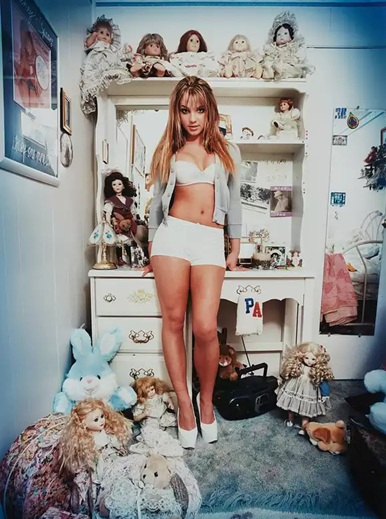
The photoshoot by David LaChapelle is the stuff of pop culture iconography. That Teletubby image has been replicated countless times over (at the time, certain conservatives were furious that Tinky-Winky might be gay propaganda because of his fierce handbag), but it’s the other images inside the magazine that reveal more explicitly how Spears was moulded as a teenage sex symbol for a presumably older male audience. In one, Britney is shot in her childhood bedroom surrounded by her porcelain dolls and plushie bunny toys, while she wears a white bra and matching shorts and looks down the camera with what feels like a teen girl’s attempt to be sultry. In another, she is shot from behind, looking back at the lens while pushing a hot pink bicycle and wearing white shorts with BABY bedazzled on one cheek. She is 17 in these images.
LaChapelle’s work is known for its garish camp, in-your-face vibrancy, and hyper-real explorations of sex and good/bad taste. By 1999, he was synonymous with a certain kind of celebrity photoshoot: retina-burning colours, unexpected scenarios, and a sense that the subject might not entirely be in on the joke (see his photo of the Kardashian-Jenner clan that they apparently used for their Christmas card one year.) His best work was usually with women as consciously over-the-top as he: Amanda Lepore, Pamela Anderson, Madonna, Lady Gaga. One could see why he’d be perfect to capture the impending mania of the teeny bopper millennium, but his gaze of artifice and sex feels askew with a teenage girl at its centre.
In interviews, LaChapelle talked about how Spears was his collaborator in this shoot, being as eager to sex it up as he was. He described one incident where she “pretended” to be uneasy with the setup when her manager saw it, then had him locked out of the room so that she could bare her midriff. Britney remembered differently, saying that she didn’t quite understand the implications of posing in her bra in front of her beloved doll collection.
Whenever I think about how many people over the years insisted that Britney was always in control of her image as a literal child, I go back to this excellent piece by Tavi Gevinson in The Cut from 2021, titled, “Britney Spears was Never in Control.” As a former child celebrity who also grew up in the spotlight and was defined by rhetoric about being “wise beyond her years,” Gevinson is the ideal person to eviscerate this victim-blaming argument. As she notes, there was a compelling power behind the argument that Britney was just proud about her sexuality and anyone uncomfortable with a teen girl being marketed this way was playing into misogyny. “Britney was in charge” makes it easier to sideline the very real issues of how culture fetishizes young girls and women, and turns their exploration of their own desires into fodder for adult men. As Gevinson savvily put it:
“If teen girls — or young women — are encountering adult men socially, they are navigating norms and expectations that were built to rationalize men’s behavior. They are not inured to power imbalances or how power may complicate consent. They are not historically taught to leave a sexual encounter the moment that it becomes violent or to subordinate men’s desires in favor of their own pleasure or safety. They are taught to be responsible for the actions of sexual predators, who receive a vast margin of plausible deniability. When I’ve met 18-year-olds in the last couple years, I have been struck by the fact that even if someone is precocious, it is their youth that makes them precocious. If you can still be considered “mature for your age,” you are not an older person’s equal. This observation can easily go from an act of respect to license for harm.”
Modern reinterpretations of Spears’ narrative, as Gevinson calls out, try to rewrite her as an unexpected feminist icon whose assertion of her sexual and personal independence were what made her enticing to young girls, not her sexiness. We want to believe these stories because we want to empower a woman who was so thoroughly stripped of it over the course of her life, but it doesn’t ring true. Britney wasn’t a fierce feminist of the ‘90s: she was sold to us as the opposite of that, as the alternative to the riot girls and Jagged Little Pill singalongs that fuelled an era of women-driven songwriting. This is not to shame a literal teenage girl for trying to put her own stamp on her image as rooms full of men older than her father counted the dollar bills. But as Gevinson wrote, it’s easier to make the girl the problem than the system.
Such was the bind of Britney. She was expected to be a midriff-bearing sex symbol who men could safely sexualize, but only if she maintained the conservative image of a God-fearing girl who was saving herself for marriage. Every kind of pervert could have their actions excused – such as having a countdown clock to Spears’ 18th birthday – because her faith made it seem more “proper.” It is a uniquely constricting kind of weaponized sex positivity that barely conceals its shaming intent. Only a couple of years after this piece, Spears would be dragged through the mud and derided as a “slut” because Justin Timberlake made it clear to anyone who would listen that they were indeed having sex as an unmarried couple and that Spears may have cheated on him.
Thanks for reading Gossip Reading Club! This post is public so feel free to share it.
As is typical with celebrity backlash of all kinds, the qualities that defined Britney positively at first were quickly weaponized against her: her innocence was now seen as stupidity (usually clocked in classism related to her Southern roots); her sex appeal was now “too much” then was derided as desperate when she put on, like, six pounds; that “empowerment” she displayed as a teen was suddenly trashy and inappropriate. Diane Sawyer made her cry by berating her over her sex life. Timberlake turned his cruelty into SNL skits. Eventually, it felt like Spears couldn’t do anything right in the eyes of the public, and even after her breakdown and conservatorship, she was expected to get back on the saddle and keep going.
As well as the Gevinson piece, the other piece of Britney-related content I always return to is the monologue Craig Ferguson gave about her as her life began to fall apart in 2007. Ferguson, a Scottish comedian with his own history of alcoholism and mental health issues, took the bravest stand in pop culture at the time by refusing to make jokes about her. As he shared his own story of addiction and suicidal ideation, he reminded his audience to offer empathy to a struggling mother of two who deserved better than what she was getting. The crowd sniggered at first but clearly came to understand the gravity of the moment. “She’s 25 years old. She’s a baby herself. She’s a baby.” I always remember that line.
Now, we all fall over ourselves to support Britney, to offer penance for the cruelty we all engaged in because everyone was doing it. Like many other women who were wronged by the press or society, we’ve sought to right our wrongs and pretend we’ve learned the right lessons. But we haven’t, not really. Britney is a mentally ill woman whose every move is still gawked at with faux-concern and giddy speculation. We are still throwing women and girls under the bus day after day, shaming them for adhering to the demands we set for them. I could be here all day listing the relevant examples.
Even in terms of teen idols and the manufacturing of adolescent sexuality for the masses hasn’t improved much. Gen Z-ers talk frequently of their discomfort with sex and growing up online with endless unrestricted access to porn. Extreme cosmetic augmentations are advertised to teens on social media. The manosphere has sunk its claws into a whole generation of young boys and men. It’s not as though the entertainment industry has become more progressive or empathetic either. I look at Millie Bobby Brown, who has said she’d love to play Britney in a biopic, and think about how her body was discoursed for years before she turned 18.
Honestly, I find talking about Britney to be really difficult and mentally taxing. It’s not fun, frankly. Not all celeb stories are, certainly not in this newsletter, but the inescapable hopelessness that permeates every corner of Spears’ story is especially smothering. The truth is, I don’t think we’ll ever find a way to fully confront how we treated Britney Spears and how the crafting of her image defined generations of women’s views on gender, sexuality, and power. Our mea culpas have been timid and quickly contradicted by attacks against women like Amber Heard, Megan thee Stallion, and Cassie Fine. Maybe we don’t get dozens of paparazzi chasing vulnerable women and their babies down the street nowadays, but the online conspiracies and hardcore political hijacking of these people’s lives is no great substitute.
Britney will always be an icon, one of the true popstars of her era. She’s more than earned her retirement, even if the public’s demand for more has never ceased. In many ways, she continues to be the vessel through which our generation confronts a tangled past. To let Gevinson have the last word:
“Even young women who are not megafamous have typically picked up on what makes them appear valuable by the age of 15. Their capacity to perpetuate these standards doesn’t mean they are not also victims of these standards. If anything, it shows how girls’ bodies and sexuality are so deeply regulated by a society that despises women and fetishizes youth that some of us learned how to carry out its work all on our own.”
Thanks for reading. You can find my work scattered across the internet. We’re headfirst into the Winter season, so let me know if there are any films, awards-related topics, or celeb stuff you’d like me to cover!
If you would like to get a full paid subscription to the Gossip Reading Club but do not want Substack to get any of your money, DM me, and I can set up everything manually! If you’d prefer to just make a tip (much appreciated!), I have a Ko-Fi page.