Issue 29: Growing Up Miley Cyrus
The once and future Hannah Montana was ready for mainstream stardom (and a very controversial photoshoot.)
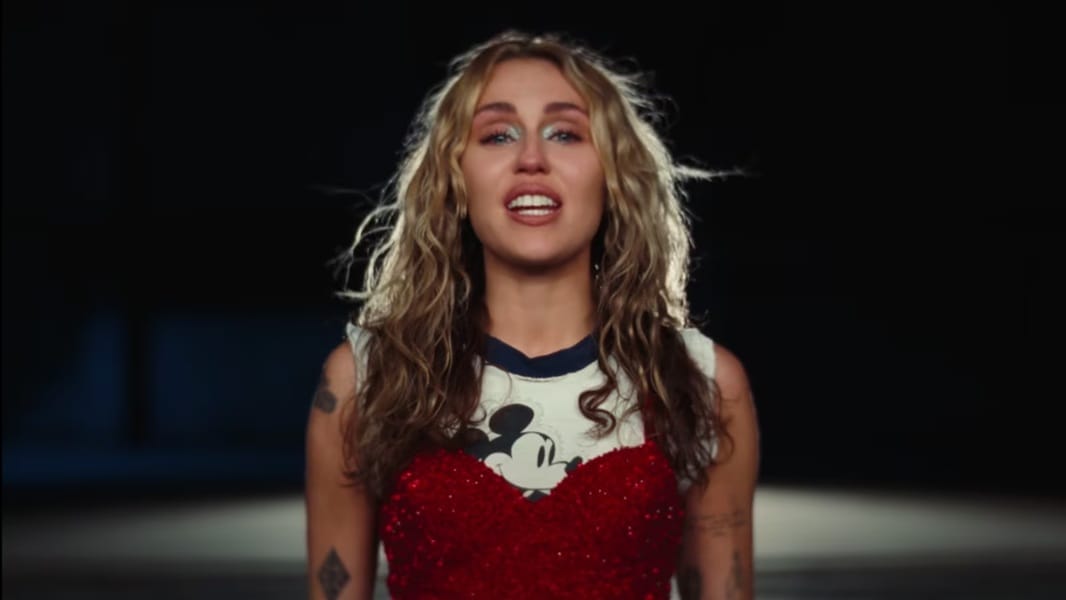
Miley Cyrus is now 32 years old. That seems shocking somehow. There’s something about being famous for that amount of time that makes outsiders imagine you as an eternal child or somehow way older than you actually are. For many, Miley will always be Hannah Montana, the Disney Channel teen idol who lived a musical double life and released a surprising array of total bops. Others see her in that flesh-coloured latex two-piece twerking against Robin Thicke. But now, she’s something of an elder stateswoman of 21st-century pop. She’s aged into a Grammy winner and Billboard hitmaker whose albums get reviewed in Pitchfork. Cyrus is, dare I say it, respectable. She’s weathered child star madness, all the growing pains, the iffy rebrands, and the changing tides of the music industry. Now, she’s a cited influence on the likes of Chappell Roan, Lil Nas X, and Troye Sivan. She was ranked as the ninth-greatest Billboard 200 female artist, ahead of U2, Adele, and Elvis.
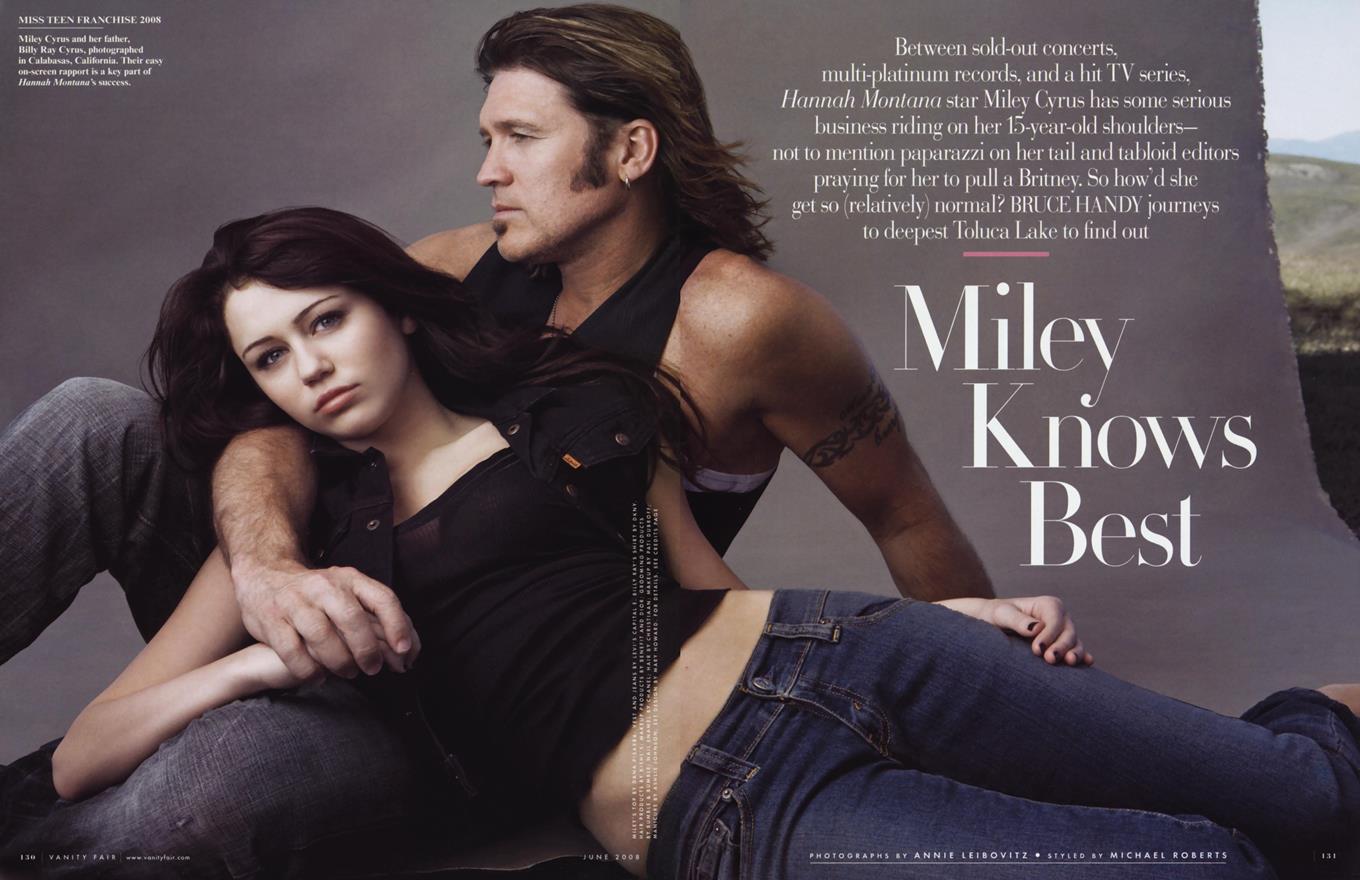
Nowadays, it’s easy to like Miley. She’s funny, candid, doesn’t care about what people think of her, and looks great doing it. In interviews, she cracks jokes while opening up about her tenure as a child star. Given how it’s horribly common for former child actors and singers to be discarded by the same business that created them, then takes joy in their downfalls, I’m always relieved when someone like Cyrus gets out of the furore in one piece. For a while, it felt like everyone was predicting her to be a future trainwreck. What a ghoulish thing to hope for with a literal child, right? In 2008, when she was only 15, she landed a profile in Vanity Fair, focusing on her growing fame. You may not remember the article, but you definitely remember that photo.
Vanity Fair. “Miley Knows Best.” June 2008. Bruce Handy.
As a child, Destiny Hope Cyrus started taking acting and singing lessons at a young age. Her first acting role was on Doc, a vaguely religious medical drama starring her father, Billy Ray Cyrus of “Achy-Breaky Heart” fame (and that one scene in Mulholland Drive.) She auditioned for some bigger films but got her big break at the age of nine when she auditioned for a new project on the Disney Channel. It was about a regular girl who has a secret identity as a mega-famous popstar. It didn’t take long for Hannah Montana to become a very big deal.
Within a year of its premiere, Miley (the name comes from her childhood nickname of “Smiley”) had Billboard hits as both herself and Hannah Montana. She went on tour, selling millions of tickets, and her concert film received a theatrical release. I was too old for Disney Channel stuff by this point in my life, but I remember when Miley Mania crossed the Atlantic. Between her, Selena Gomez, Demi Lovato, the Jonas brothers, and the High School Musical kids, the Disney Channel went global in a way it hadn’t before. Social media was in its infancy, and sites like Perez Hilton and Just Jared feverishly covered the lives of these literal kids. Cyrus seemed to be the most intriguing to many: the daughter of a country star who counted Dolly Parton as her godmother!
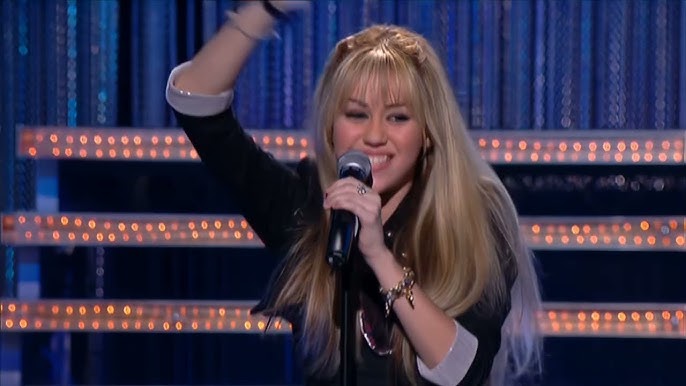
Certainly, Disney was priming her for stardom well beyond the teeny bopper demographic. She’d signed a record deal with a Disney-owned company, Hollywood Records, to release non-Hannah music. This Vanity Fair profile was released at the same time as her second studio album, Breakout. This is the one with “See You Again” and “7 Things” on it, which were seen as edgier than her Disney stuff (which is a low bar, yes, but it was still there.) Reviews were mixed to positive, with many critics feeling the songs were still too Montana-ish, but that the potential for something bigger was there. Breakout wasn’t a push to make her seem more mature, per se. It’s still a very teen girl album and the best songs are rooted in that proud petulance. But it was a sign of her ageing into adulthood, and a demonstration that Miley was ambitious beyond the confines of Disney.
(Image via YouTube.)
What makes Miley a hit, Vanity Fair wanders? “Cyrus is cute, but not too cute,” they claim (ew), and has a unique singing voice for someone her age, more country than pop. “Hannah Montana is on occasion actually kind of funny,” they say, a real “damning with faint praise” moment. Of course, if you’re older than 12, the show really wasn’t for you.
The opening line to the piece is Miley declaring that her favourite TV show is Sex and the City. Honestly, it was mine when I was that age too. Every teen girl I knew watched it, almost like an anthropological study of what adults were meant to be. It’s not that odd for a teenager to be into something unsuitable for our age range – hell, it’s practically a requirement of adolescence – but in this context it certainly feels like Vanity Fair wants to show how mature and, ugh, grown-up Cyrus is. She’s in charge!
“I can’t imagine that her minders at the Walt Disney Company want to see Miley Cyrus’s name anywhere near the word “sex,” not in an era when every under-age actress in Hollywood is stalked by the Ghost of Britney Future,” says the journalist, bluntly but not inaccurately. Disney was priming Miley to be “the biggest child star since Shirley Temple, give or take a couple of Macaulay Culkin movies, or an Olsen twin.” Conde Nast Portfolio magazine had predicted she’d be a billionaire before she was old enough to vote. How do you maintain that brand? By keeping your 15-year-old subject on a tight leash.
After the show’s premiere in March 2006, Cyrus became very busy. According to the piece, she hadn’t had more than a day off in about 18 months and wasn’t expected to get another until Christmas. She’d been out of traditional school since 6th grade and missed out on most high school experiences. Even with the state-mandated child actor shortened work days, that’s a ridiculous schedule.
(It’s the cliiiiiiiiiimb. Image via YouTube.)
Miley doesn’t complain during any of this. She talks enthusiastically about her career and future. The writer compares her rat-a-tat-tat fast speaking to Rosalind Russell in His Girl Friday and wonders if it’s “a by-product of growing up around agents.” She’s not precocious or presented as a wiser-than-her-years child star like many of her predecessors. Remember how the likes of Jodie Foster were presented as though they were adults in small bodies and talked about as such.
Still, Miley is a product of the industry. when asked whose career she’d like to follow, she says that she wants to make her own path because the industry doesn’t have room for a thousand Mileys or Hilary Duffs. It’s a smart answer that feels very natural but still PR-trained. She doesn’t even trash-talk the paparazzi who had become increasingly invasive during this time. “We’ve become friends,” she declares. Her mother Tish celebrates how her teen daughter has been “really great” about the negative attention. “She just laughs about it.”
It’s all a family business too. Tish and younger sister Noah are on set for the shoot. Billy Ray is present in these photos. Her homey Tennessee roots are seen as a benefit of her future fame, a way to remain grounded. But she’s also a nepo baby who was born into the business. It’s seen as a solid balance for a child star: good to follow in your dad’s footsteps because he’s arguably a better guide than some nefarious agent or stage parent who needs the bills paid.
“With Lindsay Lohan rehabbed and Britney Spears under psychiatric care, the tabs are looking to Cyrus to flame out, or at least do something mildly outrageous,” Vanity Fair writes. They weren’t wrong. People were almost feverish at the prospect of a teenage girl falling out of nightclubs sans underwear. This was the same time when the Harry Potter kids were entering late adolescence and the press was openly leering at Emma Watson, as well as teen girls like the Olson twins.
Thanks for reading Gossip Reading Club! This post is public so feel free to share it.
There had already been some minor “drama” when images from Cyrus’s MySpace page featuring her and a female friend almost kissing went viral. Miley’s response is kind of great, as she says it wasn’t embarrassing and everyone needed to get over it. The journalist asks if the “people around you” worry about the Spears-Lohan precedent. Again, his interview subject is 15. Frankly, she comes across as more mature than him in many of her answers. He was clearly hoping for her to throw Lohan or Spears under the bus, and Miley chooses empathy. “Basically, they’re being normal 21-year-olds, especially Lindsay. I mean, most of that’s pretty normal. If you went to most high schools, I could point out Britneys and Lindsays [...] I know those people and I know they have good hearts and they’re struggling.”
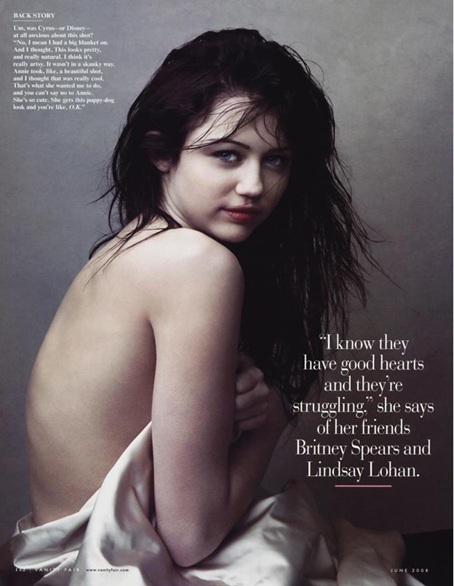
But we can’t discuss this profile without getting into that now-infamous photograph of Miley with a sheet covering her front and leaving her back bare. It caused a firestorm of controversy. Vanity Fair was accused of making child p*rnography. Photographer Annie Leibovitz was seen as fetishizing a teen girl, not unlike the ways that Brooke Shields was openly sexualized as a teen during her Calvin Klein ad days. Says the interviewer, “the topless but demure portrait accompanying this article could be seen as another baby step, as it were, toward a more mature profile.” If this whole profile is about revealing the Miley behind the Hannah, this pic is at least thematically consistent.
(Image via Vanity Fair.)
Said Cyrus in the piece, “Annie took, like, a beautiful shot, and I thought that was really cool. That’s what she wanted me to do, and you can’t say no to Annie. She’s so cute. She gets this puppy-dog look and you’re like, O.K.” I wonder if she was hyped to get the Leibowitz treatment. Even now, at her most creatively uninteresting, a Leibowitz photoshoot is still seen as a sign that you’ve made it.
But it is, it must be said, a godawful photograph. Miley looks dead, almost Tim Burton-esque in her pallor under that harsh lighting. This is a big Leibowitz issue. She struggles to light her subjects (more so when they’re Black.) Leibowitz’s stranglehold over the Vanity Fair photoshoot really deserves a piece of its own. She’s undoubtedly a legend and a pioneer, one who defined the aesthetic of the celebrity image, but when she flops, she flops hard. This image is a weird mixture of stylistically phoning it in and playing around with some discomfiting ideas surrounding youth and idolatry. It doesn’t work.
In a statement released by Vanity Fair, Leibovitz said she was “sorry that my portrait of Miley has been misinterpreted. Miley and I looked at fashion photographs together and we discussed the picture in that context before we shot it. The photograph is a simple, classic portrait, shot with very little makeup, and I think it is very beautiful.” Annie, you lied. Fashion? Classic? Maybe in the sense that she looks like a Victorian ghost?
It was 18 when this photoshoot happened. I keenly remember how overheated the conversations around it were, and I also remember, unfortunately, how many people blamed Miley for it. They saw her as wanting to oversexualize herself or grow up before her time as she aged out of the teeny-bopper demographic. Yes, Vanity Fair and Leibovitz faced their fair share of pushback, but the fact that the adolescent at the heart of it was also treated as a culprit was revealing.
And, of course, Miley had to apologize for it. Jesus, remember when we used to force women to apologise for being sexualized or degraded by men? “I took part in a photo shoot that was supposed to be ‘artistic’ and now, seeing the photographs and reading the story, I feel so embarrassed,” she said in a statement. “I never intended for any of this to happen and I apologize to my fans who I care so deeply about.” Was it her fans who were mad? Or their parents, who couldn’t get over their glorified TV babysitter not actually being Hannah Montana?
The Disney Channel called out Vanity Fair and Leibowitz for what they described as “a situation [that] was created to deliberately manipulate a 15-year-old in order to sell magazines.” I mean, yeah, but also you’re Disney and nobody wants to hear your moral grand-standing on kids being used for the purposes of profit. Remember Bobby Driscoll? Or a huge majority of former child stars?
This happened a year after Britney Spears’ much publicized breakdown. Like Miley, Britney was a Disney kid crafted for stardom from an early age and shaped by a ‘family values’ corporation that prized a near-fetishistic image of virginal femininity. Like Miley would later do in her career, Britney made a splash with a sexy rebranding that was wildly popular and inspired endless social scorn from conservative circles. Spears famously found herself in the double bind of being both engineered to be leered at by adult men while simultaneously scolded by them for being ‘too sexy.’ In order to make that image work, it had to rely in this, in hindsight, absurd idea that an adolescent girl under the employ of several rich old men had 100% control over her professional choices. See, Britney wants to be styled pornographically! She’s the one making us do this. So, it’s okay to both perv over and condemn her as a harlot!
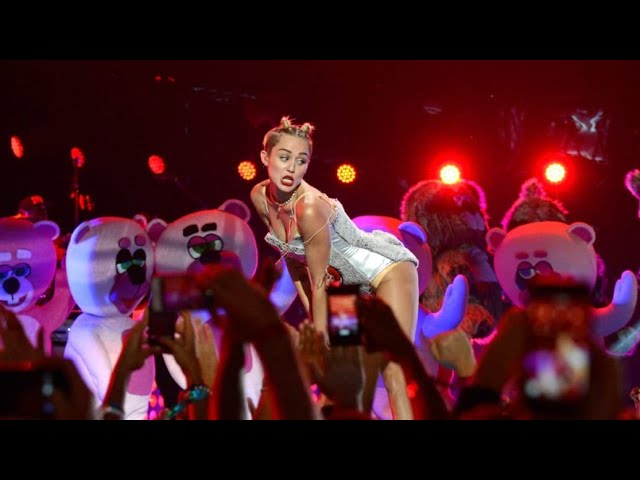
The Miley photoshoot echoed a lot of the tone of the Spears discourse from the early years of her megastardom. It’s always far easier to hate girls and women than to confront a patriarchal poison that has only grown more powerful. This is something that would follow Cyrus into her adult years as she created a bawdy and consciously camp image that both embraced the cliches of the ‘all grown up child star’ evolution and mocked them. While her appropriation of Blackness and endless twerking was a questionable choice, I do think a lot of her Bangerz era was decidedly not for straight male consumption. It was drag, so over the top and off-putting at times that it practically dared you to drool. Granted, I think she could have done that without using Black womanhood as an accessory or working with Terry Richardson. But the intention seems clearer now than it did at the time. I don’t think Miley was for the boys.
(Image via YouTube.)
Of course, we cannot talk about this era of Disney Channel stars and public shaming without getting into purity rings. The George W Bush administration pandered heavily to the evangelical demographic through homophobic legislation and a dangerous advocacy for abstinence-only sex education in schools. One aspect of this was the extremely creepy purity rings movement, wherein adolescents (but mostly teenage girls) swore to save themselves for marriage and wore a ring to publicly demonstrate their commitment to Jesus. Some girls attended purity balls where they made this promise to their fathers. I’d like to say we’re over this in 2025 but, you know, have you seen the world?
A lot of Disney Channel stars from this mid-2000s era wore purity rings. The Jonas brothers were so notable for it that South Park mocked it in a very funny episode wherein an evil Mickey Mouse said the obvious: that public virginity pledges made it easier for corporations to sell teenagers as sex objects to their fans. Selena Gomez wore one. So did Demi Lovato. Miley spoke of her purity ring in 2008, telling TV Guide, “I like to think of myself as the girl that no one can get, that no one can keep in their hand. Even at my age, a lot of girls are starting to fall and I think if [staying a virgin] is a commitment girls make, that’s great.”
The goal was to push a conservative agenda onto kids, but it also made all of these teenagers’ virginities a topic of public speculation. The exact same thing happened to Britney Spears, who was shamed for having sex with Justin Timberlake while he was all but applauded. When Russell Brand -- ugh -- made jokes about purity rings at the 2008 MTV Video Music Awards, Jordin Sparks from American Idol and said, “It’s not bad to wear a promise ring because not everybody – guy or girl – wants to be a slut.” She was only 18 at the time and regretted the wording choice.
Pretty much every teen celeb of that time who wore a purity ring has talked about the complicated emotions in brought up in their lives in the ensuing years. Trying to navigate adolescence is hard enough when it’s not your job to be a Role Model moulded by a family-friendly corporation. Demi Lovato talked about being raped as a teen and how being “a part of that Disney crowd that publicly said they were waiting ‘till marriage,” prevented them from speaking out on her trauma.
The Vanity Fair piece ends with Miley having to stave off some creeps with a stack of photos for her to sign. She and her family get into an S.U.V. and leave the restaurant where the interview took place. The writer asks one of the many paparazzi chasing her, “how great a meal ticket Miley is, really. “She’s not Britney,” he says, “but she’s up there.”” They wanted fresh meat and Disney, the Cyrus parents, and the magazine gave them it.
Cyrus has spoken pretty positively about her time as a child star under the reign of the House of Mouse. She credits Disney with instilling in her a strong work ethic and received a Disney Legend award in 2024. But I think it’s impossible to navigate her career and how it evolved without delving into the ways she was treated as a kid, both by the world and her bosses. They made her apologize, as a 15-year-old, for a photoshoot. They had these kids forced into the impossible bind of being relatable megastars and the faces of a creepy anti-sex religious movement. Frankly, it’s kind of a miracle that Cyrus isn’t super messed-up. The industry certainly set her up to fail.
The Disney machine is still moulding kids into stars – check out that whole Descendents universe – but not in the same way it once was during Miley’s era. Did influencers and the even more insidious machine of online fame take over that cycle for child stardom? Talk about a cursed monkey’s paw deal. The cycle of child labour exploitation under the guise of celebrity will sadly never cease. Until we get true legislative change to protect these kids (often from their own families), we just have to hope for the best. Maybe Miley can offer a few tips.
Thanks for reading.
My work is scattered across the internet. Over on Pajiba, I wrote about the history of celebrities taking big paydays from dictators, Oprah’s history of celebrating junk science, and the brainrot era of overconsumption. You can also check out my TIFF 2025 coverage there.
I delved into the most 2007 movie ever made, Southland Tales, for Crooked Marquee. To celebrate the second season of Interview with the Vampire dropping on Netflix, I talked about the ways the adaptation improves on my all-time favourite books for Inverse. I listed some fun SFF movie novelizations for The Portalist.
If you’d like to sign up for a paid subscription to the Gossip Reading Club but would rather bypass giving Substack your money, DM me and we can set one up manually. If you’d rather make a one-off tip of gratitude, I have a Ko-Fi account.